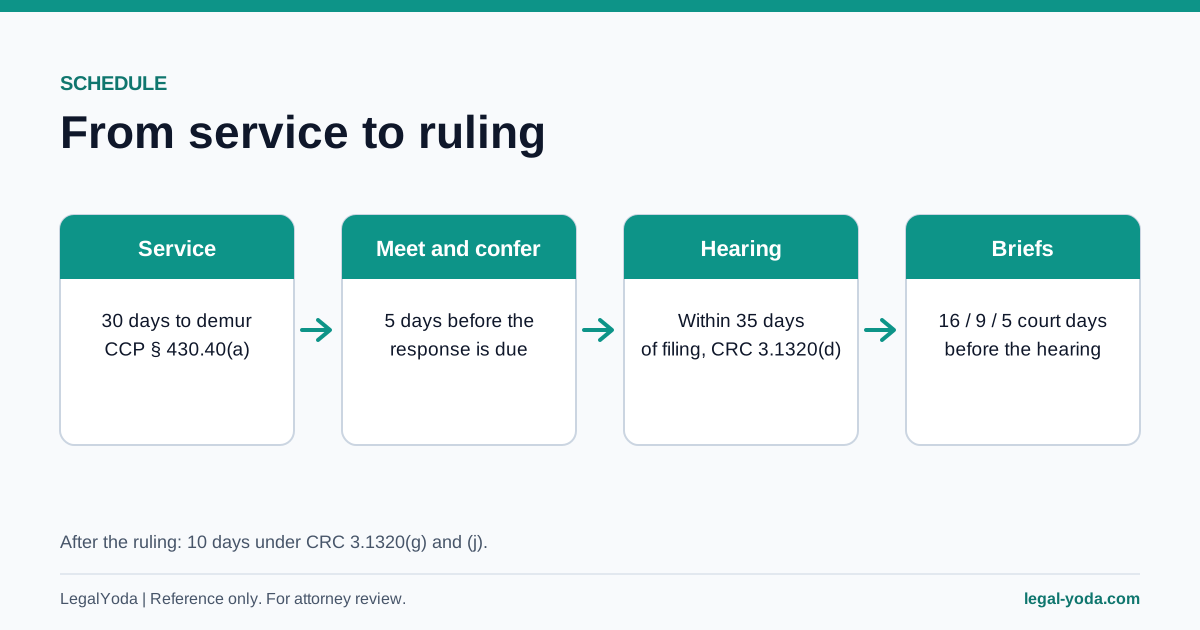
A demurrer touches several clocks at once. One starts when the complaint is served, one when the demurrer is filed, one counts backward from the hearing, and one starts when the court rules. This article puts them in order, using the cached text of CCP §§ 430.40, 430.41 and 1005 and CRC 3.1320. It assumes an ordinary civil action in superior court; unlawful detainer and local rules change some of the dates.
Stage one: the response period
CCP § 430.40(a) allows a person against whom a complaint or cross-complaint has been filed to demur within 30 days after service. The 30 days run from service, and the computation rules in CCP §§ 12 and 12a govern how the last day is counted. For a demurrer to an answer, CCP § 430.40(b) gives 10 days after service of the answer.
CCP § 412.20(a)(3) is the summons provision that tells the defendant the response is due in 30 days. A timely demurrer is a response to the complaint, which is why it delays the answer.
Stage two: meet and confer
CCP § 430.41(a)(2) requires the parties to meet and confer at least five days before the date the responsive pleading is due. If they cannot, the demurring party gets an automatic 30-day extension by filing and serving, on or before the date a demurrer would be due, a declaration under penalty of perjury that a good faith attempt was made and explaining why the conference could not take place. The extension runs from the date the responsive pleading was previously due. Further extensions need a court order on a showing of good cause.
Putting the two together, the working calendar for a defendant has a date five days before the response is due, as well as the response date itself. The details of the conference are in the article on the meet and confer requirement. The extension declaration is a separate paper from the declaration that accompanies the demurrer under subdivision (a)(3).
Stage three: filing and the hearing date
CRC 3.1320(c) requires the demurrer to be filed with a notice of hearing that specifies a date in accordance with CCP § 1005. CRC 3.1320(d) says demurrers must be set for hearing not more than 35 days following filing, or on the first date available to the court thereafter. For good cause, the court may order the hearing held earlier or later on notice it prescribes.
The hearing date is the anchor for everything that follows, and in many counties it comes from a reservation made before filing. The county pages on this site describe how sixteen counties handle reservation, based on verified local rules.
Stage four: counting back from the hearing
CCP § 1005(b) sets three dates counted backward from the hearing in court days. Moving and supporting papers are due at least 16 court days before. Opposition papers are due at least nine court days before. Reply papers are due at least five court days before. CCP § 12c(a) confirms that the last day to act is found by counting backward from the hearing, excluding the hearing day.
Service method can add days to the 16-day notice. By the cached text, service by mail adds five calendar days within California, 10 outside California but in the United States, and two calendar days for fax, express mail or overnight delivery. CCP § 1013 does not extend the opposition and reply dates. Electronic service has its own two-court-day extension under CCP § 1010.6(a)(3)(B), whose interaction with § 1005(b) should be checked in the current code.
Stage five: papers served after filing
CCP § 1005(c) requires opposition and reply papers to be served by a means reasonably calculated to ensure delivery not later than the close of the next business day after they are filed. So each brief carries two dates: the date it must be filed and served by, and the delivery rule that follows filing.
The court may prescribe a shorter time, a point § 1005(b) repeats. A department that issues tentative rulings the day before the hearing makes the last days of the window matter more, because a paper filed at the edge of the window may not be read before the tentative is written.
Stage six: after the ruling
CRC 3.1320(g) deems leave to answer or amend within 10 days granted following a ruling, unless the court orders otherwise, and five calendar days in an unlawful detainer. CRC 3.1320(j) gives the defendant 10 days to answer or otherwise plead after the overruling of the demurrer, after the time to amend expires, or after the sustaining of the demurrer without leave to amend.
The cached rule does not say from what event the 10 days in subdivision (g) begin, so confirm that in the current rule and in the order. If the court orders a conference under CCP § 430.41(c), the time to demur to an amended pleading does not begin until the conference ends.
The sequence in one list
Order of events for an ordinary civil action, with the source for each:
- Service of the complaint starts the 30 days under CCP § 430.40(a).
- Meet and confer at least five days before the response is due, under CCP § 430.41(a)(2).
- File the demurrer with a notice of hearing set within 35 days of filing, under CRC 3.1320(c) and (d).
- Moving papers 16 court days, opposition nine, reply five, all before the hearing, under CCP § 1005(b).
- Hearing and ruling, then 10 days under CRC 3.1320(g) and (j).
Related articles
Reference only. Not legal advice. LegalYoda is a document preparation service, not a law firm.