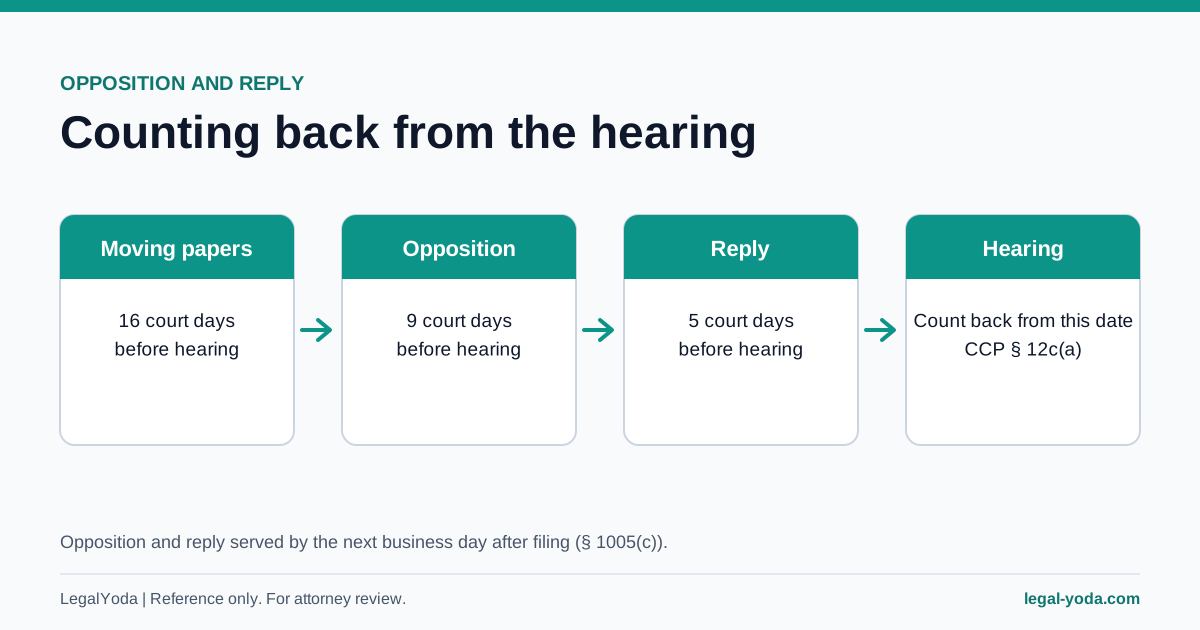
The party that filed a demurrer controls the hearing date. The other side then has to work backward from it. This article covers the two dates that follow the moving papers: when the opposition is due and when the reply is due. It uses the cached text of CCP § 1005 and the related counting and service statutes, and it marks the points where the cache stops and the current code or the local rules must be read.
The two dates: nine court days and five court days
CCP § 1005(b) gives the rule for papers filed in response to a noticed motion. All papers opposing a motion so noticed must be filed with the court, and a copy served on each party, at least nine court days before the hearing. All reply papers are due at least five court days before the hearing. The same subdivision opens with the moving papers, which are due at least 16 court days before the hearing.
Both dates are measured from the hearing, not from the date the demurrer was served. That is the main difference from the 30-day response period for a complaint. If the hearing moves, every date in the chain moves with it.
How to count back from the hearing date
CCP § 12c(a) says that where a law requires an act no later than a specified number of days before a hearing date, the last day to perform it is found by counting backward from the hearing date, excluding the day of the hearing as provided by CCP § 12. Subdivision (b) adds that any extra days tied to a method of service are also counted backward from the day found under subdivision (a).
CCP § 1005 speaks in court days. The cache does not define the term, but CCP § 12a treats Saturdays and the holidays listed in CCP § 135 as holidays for deadlines that end on them. Count back across weekends and judicial holidays and confirm the result against the court’s own calendar, because a court can close on days that are not statewide holidays.
Filing is not the same as serving
Section 1005(b) requires opposition and reply papers to be filed and served by the stated date. Subdivision (c) adds a delivery rule: opposition and reply papers must be served by personal delivery, facsimile transmission, express mail, or other means consistent with CCP §§ 1010, 1011, 1012 and 1013, reasonably calculated to ensure delivery to the other party not later than the close of the next business day after the papers are filed.
In practice that means a paper filed on the last permitted day still has to reach the other side the next business day. Filing late in the day and serving by ordinary mail does not satisfy subdivision (c), because mail is not a method reasonably calculated to deliver by then.
Extensions for mail and electronic service
The cached text of CCP § 1005(b) states that CCP § 1013, which adds days after service by mail, does not apply to a notice of motion, papers opposing a motion, or reply papers governed by that section. So the mail extension that applies to the 16-day notice does not stretch the opposition or reply dates.
Electronic service is a separate question. CCP § 1010.6(a)(3)(B) extends periods after service by electronic means by two court days, and it says the extension applies in the absence of a specific exception in another statute or rule. Whether the cached language of § 1005(b) is such an exception for opposition and reply papers is not answered by the cache. Check the current statute and any court order before relying on an extension.
CCP § 1010.6(a)(4) also fixes when electronic service is deemed made: a document served electronically on a court day is deemed served that day, and one served on a noncourt day is deemed served on the next court day.
The court can prescribe a shorter time
Section 1005(b) begins with the phrase unless otherwise ordered or specifically provided by law, and it closes each timing sentence with the statement that the court, or a judge, may prescribe a shorter time. A scheduling order, a stipulation approved by the court, or a department’s own practice can therefore change the dates. Read the minute order for the hearing before calendaring from the statute alone.
Local rules also add timing. Some counties require opposition and reply papers to reach counsel sooner than the statute does, or set a tentative ruling schedule that makes any paper filed late in the window hard to use. The county pages on this site list the verified rules for sixteen counties. Rules for other counties are not covered and must be read on the court’s website.
What happens to a late paper
The cache does not include the rule on late-filed papers, and this article does not state what a court does with them. That is a matter of the rules of court and of the judge’s discretion. For an opposition, the practical point is that the tentative ruling may issue before a late paper is read. For a reply, the same is true. Verify the current rule and the department’s practice before filing outside the window.
Calendar checklist
Dates to enter once the hearing date is known:
- The hearing date and the minute order or notice that sets it.
- Nine court days before the hearing for opposition papers, counted back under CCP § 12c.
- Five court days before the hearing for reply papers.
- The next business day after each filing for service under CCP § 1005(c).
- Any shorter time the court prescribed and any local rule that moves the dates.
Related articles
Reference only. Not legal advice. LegalYoda is a document preparation service, not a law firm.