In California civil litigation the time to respond to a complaint is short, and a demurrer is one of the responses that has to be on file inside it. This article walks through the California demurrer deadline as the statutes read, the extensions that exist, and the points an attorney should confirm before relying on a calendar date. It is reference material for licensed attorneys. It does not replace reading the current code.
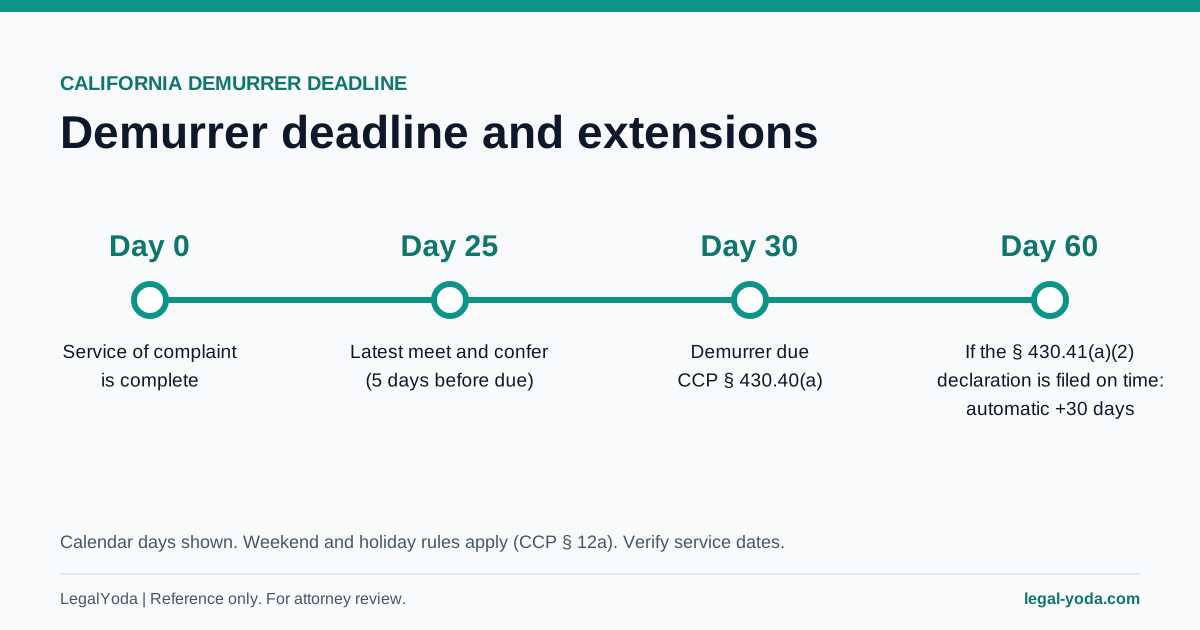
The California demurrer deadline: 30 days after service
The starting rule is in CCP § 430.40(a). A person against whom a complaint or cross-complaint has been filed may, within 30 days after service of the complaint or cross-complaint, demur to it. The same section, in subdivision (b), gives a party who filed a complaint or cross-complaint 10 days after service of the answer to demur to the answer.
Three practical points follow from the wording. The period is counted in days after service, not days after filing. It applies to a cross-complaint as well as a complaint. And the statute describes the time within which a party may demur, so a calendar entry should be built from the date service was complete rather than from the date the paperwork arrived on someone's desk.
When service is complete and the 30 days begin
The date service is complete depends on how the summons and complaint were served. The cached text of the service statutes supports the following.
- Personal delivery: service is deemed complete at the time of delivery (CCP § 415.10).
- Notice and acknowledgment by mail: service is deemed complete on the date a written acknowledgment of receipt is executed, if the acknowledgment is returned to the sender (CCP § 415.30).
- Mail to a person outside California, first-class with return receipt: service is deemed complete on the 10th day after mailing (CCP § 415.40).
- Substituted service: CCP § 415.20 sets the completion rule, which attorneys should read in the version currently in effect. The cached text shows that section is scheduled to be repealed on January 1, 2027, so check what replaces it.
Counting the days: weekends and court holidays
Under CCP § 12, time is computed by excluding the first day and including the last, unless the last day is a holiday, in which case it is also excluded. CCP § 12a(a) adds that if the last day for an act falls on a holiday, the period runs to and including the next day that is not a holiday, and for that purpose Saturdays are holidays. CCP § 135 ties judicial holidays to Government Code § 6700 with listed exceptions.
Because the list of judicial holidays has exceptions and changes, a date that lands near a holiday deserves a second look against the current statutes. The LegalYoda deadline calculator counts from the service-complete date and applies a California court-holiday calendar, and its output is meant to be checked, not adopted blindly.
Extension by stipulation or court order
Rule 3.110(d) of the California Rules of Court says the parties may stipulate without leave of court to one 15-day extension beyond the 30-day period prescribed for the response after service of the initial complaint. Rule 3.110(e) provides that the court, on its own motion or on a party's application, may extend or otherwise modify the times in the rule.
A stipulation should be in writing and in hand before the original date passes. The cached rule text does not address every detail of how a stipulation is documented or whether a particular court wants it filed, so check the local rules and the assigned department's procedures.
The automatic 30-day extension under CCP § 430.41
CCP § 430.41(a) requires the demurring party to meet and confer before filing. The parties must meet and confer at least 5 days before the date the responsive pleading is due. If they cannot, the demurring party is granted an automatic 30-day extension by filing and serving, on or before the date a demurrer would be due, a declaration under penalty of perjury that a good faith attempt to meet and confer was made, explaining why the parties could not meet and confer.
The statute states that the 30 days commence from the date the responsive pleading was previously due, that the demurring party is not subject to default during the extension, and that any further extension requires a court order on a showing of good cause. In practice this means the declaration is itself a deadline: it has to be filed and served by the original due date, not after it.
Mail and electronic service extensions: verify before stacking
CCP § 1013(a) extends periods that run after service of a document by mail by five calendar days when the place of mailing and the place of address are both in California, with longer extensions for other locations. CCP § 1010.6(a)(3)(B) extends such periods by two court days after service by electronic means, subject to listed exceptions.
Those extensions are written for service of documents after a case is underway. For a complaint served with a summons, the completion rules in the service statutes listed above already determine when service is complete. Whether any further extension applies to a given method of serving the original complaint is a question to verify against the current code and case law rather than assume. Do not add days to the calendar on an assumption.
A motion to strike does not extend the time to demur
CCP § 435(d) states that filing a notice of motion to strike does not extend the time within which to demur. Under § 435(c), a party who serves and files a notice of motion to strike without demurring has the time to answer extended, subject to the exceptions the statute names. The two provisions do different things, so a motion to strike filed alone is not a way to preserve a demurrer.
A short checklist for the demurrer deadline
Before the date is final, confirm each of these items against the file and the current code.
- The method of service and the date service was complete under the applicable service statute listed above.
- Whether the period ends on a Saturday or a judicial holiday.
- Whether a written stipulation to the one 15-day extension exists under CRC 3.110(d).
- The date, at least 5 days before the due date, by which the meet and confer must occur.
- The date by which a § 430.41(a)(2) declaration must be filed and served if the meet and confer cannot happen in time.
- Any local rule or department procedure that affects hearing reservations.
Related articles
Reference only. Not legal advice. LegalYoda is a document preparation service, not a law firm.