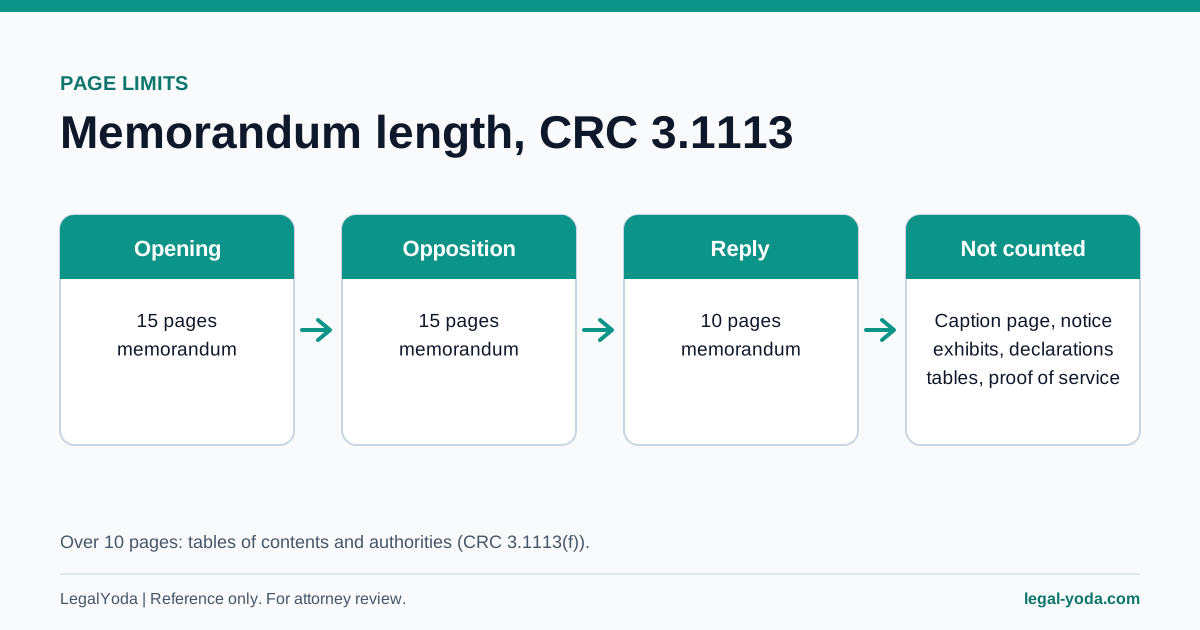
Page limits for demurrer briefs sit in CRC 3.1113, not in the demurrer statutes. The limit applies to the memorandum, not to the whole filing, and it changes depending on which brief is being written. This article walks through the cached excerpt of rule 3.1113 and the related rule 3.1112, and it flags what the excerpt does not cover so that nothing is assumed.
The page limits for a demurrer memorandum
CRC 3.1113(d) says that, except in a summary judgment or summary adjudication motion, no opening or responding memorandum may exceed 15 pages. In a summary judgment or summary adjudication motion the limit for opening and responding memoranda is 20 pages. No reply or closing memorandum may exceed 10 pages. A demurrer is not a summary judgment motion, so for a demurrer the numbers are 15 for the opening memorandum, 15 for the opposition, and 10 for the reply.
The cached text is an excerpt, and it speaks of a motion, a special demurrer and a demurrer in subdivision (a). The excerpt applies the memorandum requirement to demurrers by name. Counsel should still read the full current rule for any wording that changes the limit for a particular filing.
What the page limit does not include
The last sentence of CRC 3.1113(d) says the limit does not include the caption page, the notice of motion and motion, exhibits, declarations, attachments, the table of contents, the table of authorities, or the proof of service. For a demurrer package that means the notice of hearing, the demurrer itself, the meet and confer declaration and the proof of service sit outside the count.
The excerpt does not say how a combined document is measured when the notice, demurrer and memorandum are in one file. CRC 3.1112(c) allows the papers to be combined if the combined pleading specifies the items separately in its caption. Because the notice and motion are excluded from the count, the caption should make the boundary between them and the memorandum clear.
Tables and summaries for longer memoranda
CRC 3.1113(f) requires a memorandum that exceeds 10 pages to include a table of contents and a table of authorities. It also provides that a memorandum that exceeds 15 pages must include an opening summary of argument. Those rules interact with the limit: an opening memorandum or opposition of 11 to 15 pages needs both tables, and the tables themselves are not counted.
The cached text does not explain when a memorandum could exceed 15 pages. Rule 3.1113 in its full form may address a request to file a longer memorandum, but that part is not in the cache and should be read in the current rules before anyone plans a longer brief.
What happens to an oversized memorandum
CRC 3.1113(g) provides that a memorandum that exceeds the page limits of the rules must be filed and considered in the same manner as a late-filed paper. The cache does not include the rule that governs late-filed papers, so this article does not say what the court may do with one. The consequence depends on that rule and on the judge, and it can fall on the party that exceeded the limit.
Because the penalty is tied to lateness, an over-length reply or opposition can create a timing problem on top of a length problem. The opposition and reply dates are set by CCP § 1005(b), at nine and five court days before the hearing, so there is little room to cure an over-length filing once the dates have passed.
The risk of filing no memorandum
The first subdivision of the rule is also about length in a sense: CRC 3.1113(a) requires a supporting memorandum for a motion and states that the court may construe the absence of a memorandum as an admission that the motion or special demurrer is not meritorious and cause for its denial. In the case of a demurrer, the court may also treat the omission as a waiver of all grounds not supported. A demurrer ground that appears in the demurrer but is not argued in the memorandum is therefore at risk.
CRC 3.1112(a) lists the papers that support a motion: a notice of hearing, the motion itself and a memorandum. So the memorandum is not optional for a demurrer, and the page budget has to cover every ground the demurrer asserts.
Budgeting pages across several grounds
A demurrer that attacks several causes of action on several grounds has to fit all of it inside one memorandum. CRC 3.1320(a) requires each ground to be stated in its own paragraph in the demurrer, and the memorandum has to support each of them or risk the waiver described in CRC 3.1113(a). The page limit is shared across all of the grounds.
The limit also applies to the other side. An opposition memorandum is capped at 15 pages under the same subdivision, and a reply at 10, so the reply cannot restate the opening brief in full. Counting pages against the limit before the filing date, not on it, leaves time to cut.
Pagination and local additions
CRC 3.1113(h) requires the pages of a memorandum to be numbered consecutively beginning with the first page, using Arabic numerals only. The page number may be suppressed on the first page. The cache does not include the general formatting rules for line spacing, font or margins, which are in other rules of court and in local rules.
Some courts add their own length or format requirements. Among the verified county data on this site, for example, Fresno has a local rule on a separately bound appendix of authorities for certain citations. Local rules change, and the court’s current rules should be read for the county where the demurrer will be heard.
Related articles
Reference only. Not legal advice. LegalYoda is a document preparation service, not a law firm.