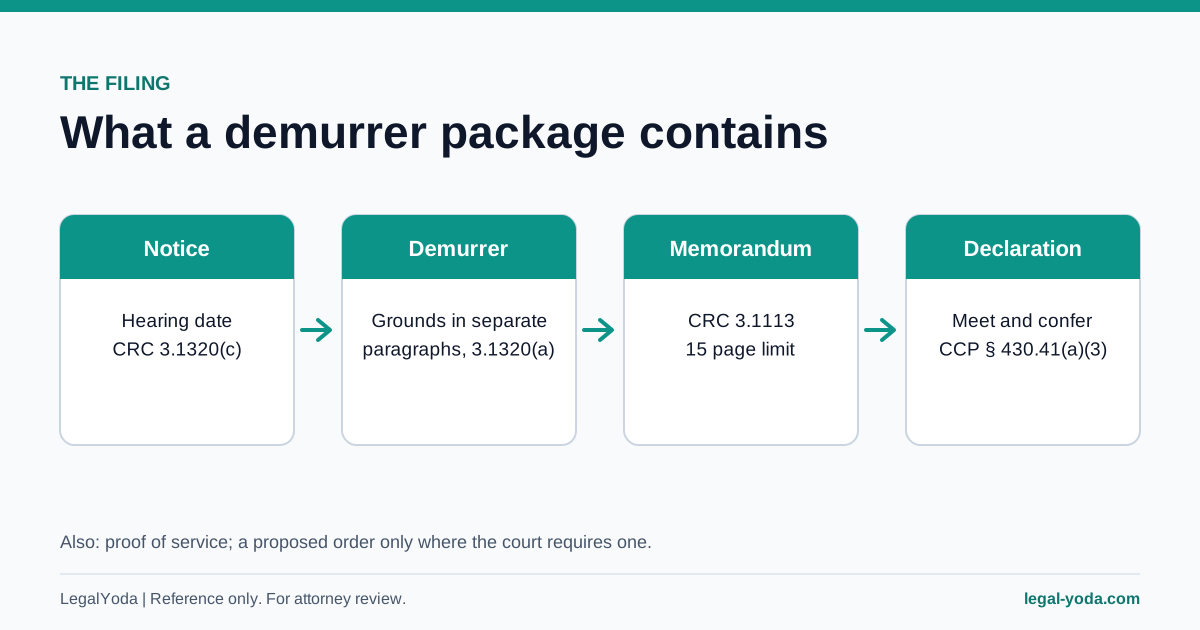
People who search for a California demurrer template usually want a fill-in document. This article is not one. It lists the papers a demurrer filing contains, what the cached statutes and rules require of each, and where the rules stop and local practice begins. Use it as a checklist against the current rules and the court’s website, not as a form.
The required papers under CRC 3.1112
CRC 3.1112(a) says that, unless the rules provide otherwise, the papers filed in support of a motion consist of at least a notice of hearing, the motion itself, and a memorandum. The rule refers to a memorandum in support of the motion or demurrer, so it applies to demurrers. Subdivision (c) allows the papers to be filed separately or combined in one or more documents if the combined pleading specifies the items separately in its caption.
For a demurrer, the motion itself is the demurrer. CRC 3.1112(d) lists what a motion must do: identify the party bringing it, name the parties to whom it is addressed, briefly state the basis and the relief sought, and, if a pleading is challenged, state the specific portion challenged.
Notice of hearing
CRC 3.1320(c) requires a party filing a demurrer to serve and file with it a notice of hearing that specifies a hearing date in accordance with CCP § 1005 and, if service is electronic, with CCP § 1010.6(a)(4) and the cross-referenced provision of CRC 2.251. CRC 3.1320(d) says the demurrer must be set for hearing not more than 35 days after filing, or on the first date available to the court afterward.
Some courts require a set paragraph in the notice. In the verified county data on this site, Riverside and Sacramento each require a stated paragraph about tentative rulings in noticed motions in certain departments. Whether a given court requires one is a question for its local rules.
The demurrer itself
CRC 3.1320(a) requires each ground of demurrer to be in a separate paragraph that states whether it applies to the entire complaint, cross-complaint or answer, or to specified causes of action or defenses. CRC 3.1320(e) requires the first page, immediately below the case number, to state the name of the party filing the demurrer and the name of the party whose pleading is the subject of the demurrer.
The grounds themselves come from CCP § 430.10 for a complaint or cross-complaint and CCP § 430.20 for an answer. CCP § 430.50 allows the demurrer to be taken to the whole pleading or to any of its causes of action or defenses. CRC 3.1320(b) lets a party demur to some causes of action without answering the others.
Memorandum of points and authorities
CRC 3.1113(a) requires a supporting memorandum and warns that the court may treat its absence as an admission that the motion or special demurrer is not meritorious, and, for a demurrer, as a waiver of all grounds not supported. CRC 3.1113(d) caps an opening memorandum at 15 pages, not counting the caption page, notice, exhibits, declarations, tables and proof of service. A memorandum over 10 pages needs a table of contents and a table of authorities.
The page limit and tables are covered in more detail in the article on the demurrer page limit. The cached excerpt of rule 3.1113 does not include every subdivision, so the full rule should be read.
The meet and confer declaration
CCP § 430.41(a)(3) requires the demurring party to file and serve with the demurrer a declaration stating either of two things. One is the means by which the party met and conferred with the party who filed the pleading and that the parties did not reach an agreement resolving the objections. The other is that the party who filed the pleading failed to respond to the meet and confer request or otherwise failed to meet and confer in good faith.
Under CCP § 2015.5, a declaration made under penalty of perjury can stand in for a sworn affidavit, and the statute sets out the form of certification, which states the date and place of execution for a declaration signed in California. Section 430.41(a)(4) adds that a court finding the meet and confer process insufficient is not a ground to overrule or sustain the demurrer.
Proof of service
Every paper served needs a proof of service. For service by mail, CCP § 1013a lists the methods of proof, including an affidavit or an attorney’s certificate that sets out the exact title of the document served, the person making service, and the date and place of deposit. For electronic service, CCP § 1013b lists the corresponding methods and requires the proof to show the electronic service address of the person making service, the date, the name and electronic service address of the person served, and a statement that the document was served electronically.
Service methods and their effect on timing are covered in the article on hearing notice requirements. The proof of service is not counted toward the page limit.
Proposed order and other papers
A proposed order is not among the papers listed in CRC 3.1112(a). Whether one is submitted with the moving papers, after the hearing, or not at all depends on the court. Among the verified county data on this site, for example, Santa Clara’s Civil Rule 8(B) states that proposed orders may not be submitted with moving papers on a regularly noticed motion unless the court orders it or a statute or rule requires it. Other courts may differ.
A request for judicial notice, when the demurrer relies on matters outside the pleading under CCP § 430.30(a), is a separate paper whose requirements are not in the cache. Check the current rules for it. Exhibits and any appendix of authorities required by a local rule also sit outside the memorandum page count.
Related articles
Reference only. Not legal advice. LegalYoda is a document preparation service, not a law firm.