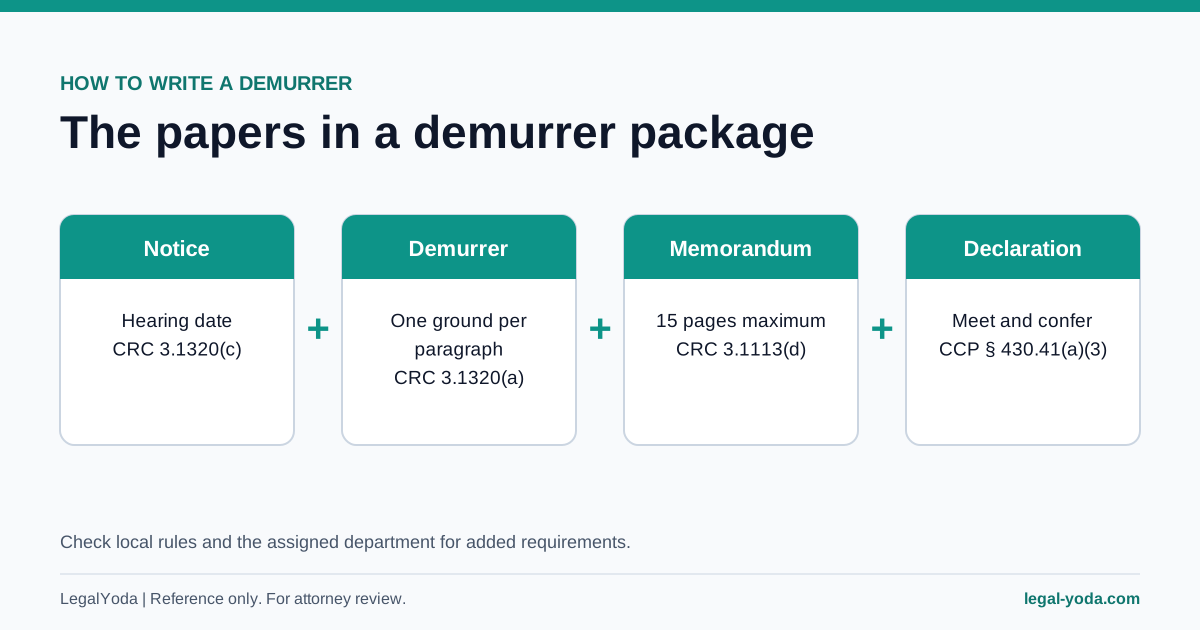
A California demurrer is a set of papers, not a single document, and the Rules of Court say what they must contain. This guide on how to write a demurrer in California follows the cached text of CRC 3.1112, 3.1113 and 3.1320 and the statutes they refer to. It covers the required papers, the caption, how to state the grounds, memorandum length and format, and the declaration. Local rules and department procedures sit on top of this and are not covered here.
How to write a demurrer in California: the required papers
CRC 3.1112(a) provides that, unless otherwise stated in the rules, the papers filed in support of a motion consist of at least a notice of hearing on the motion, the motion itself, and a memorandum in support of the motion or demurrer. CRC 3.1112(c) allows those papers to be filed as separate documents or combined in one or more documents, as long as the combined pleading specifies the items separately in the caption.
For a demurrer, CCP § 430.41(a)(3) adds the meet and confer declaration, which must be filed and served with the demurrer. The package therefore includes at least a notice of hearing, the demurrer, a memorandum, and the declaration. Whether a proposed order is also required is a matter for the local rules and the assigned department; the LegalYoda demurrer draft package includes one.
The caption
CRC 3.1320(e) requires a demurrer to state, on the first page immediately below the number of the case, the name of the party filing the demurrer and the name of the party whose pleading is the subject of the demurrer. That is in addition to the general caption requirements, which this article does not reproduce. A combined document should list each component in the caption, as CRC 3.1112(c) requires.
The notice of hearing
CRC 3.1320(c) requires a party filing a demurrer to serve and file with it a notice of hearing that specifies a hearing date in accordance with CCP § 1005 and, if service is by electronic means, in accordance with CCP § 1010.6(a)(4) and the cross-referenced provision of CRC 2.251. Under CRC 3.1320(d), demurrers must be set for hearing not more than 35 days following the filing of the demurrer or on the first date available to the court thereafter, and the court may order a different date for good cause.
The notice period is covered in the article on hearing notice requirements. CRC 2.251 is not in the repo's cache, so the cross-referenced provision should be read in the current rule.
Stating the grounds in the demurrer
CRC 3.1320(a) requires each ground of demurrer to be in a separate paragraph, stating whether it applies to the entire complaint, cross-complaint, or answer, or to specified causes of action or defenses. Each ground must also correspond to a subdivision of CCP § 430.10 for a complaint or cross-complaint, or to CCP § 430.20 for an answer.
CRC 3.1112(d) lists elements every motion must contain: identify the party bringing it, name the parties to whom it is addressed, briefly state the basis and the relief sought, and, if a pleading is challenged, state the specific portion challenged. A demurrer that names each cause of action in its own paragraph satisfies the last element naturally.
- One ground per paragraph.
- Each paragraph says which causes of action or defenses it targets.
- The ground is the one in CCP § 430.10 (or § 430.20 for an answer), not a paraphrase of it.
- Objections appear on the face of the pleading or in judicially noticeable matter (CCP § 430.30(a)).
The memorandum of points and authorities: page limits and format
CRC 3.1113(a) requires a supporting memorandum, and states that the court may construe the absence of a memorandum as an admission that the motion or special demurrer is not meritorious and, in the case of a demurrer, as a waiver of all grounds not supported. Every ground in the demurrer therefore needs argument in the memorandum.
The cached excerpt of CRC 3.1113(d) states that, except in a summary judgment or summary adjudication motion, no opening or responding memorandum may exceed 15 pages, and no reply or closing memorandum may exceed 10 pages. The page limit does not include the caption page, the notice of motion and motion, exhibits, declarations, attachments, the table of contents, the table of authorities, or the proof of service. The cached rule also has format provisions.
- A memorandum that exceeds 10 pages must include a table of contents and a table of authorities (CRC 3.1113(f)).
- A memorandum that exceeds 15 pages must also include an opening summary of argument (CRC 3.1113(f)).
- A memorandum that exceeds the page limits must be filed and considered in the same manner as a late-filed paper (CRC 3.1113(g)).
- Pages are numbered consecutively using Arabic numerals, and the page number may be suppressed on the first page (CRC 3.1113(h)).
The meet and confer declaration
CCP § 430.41(a)(3) requires a declaration, filed and served with the demurrer, that states either the means by which the parties met and conferred and that they did not reach an agreement, or that the party who filed the pleading failed to respond or to meet and confer in good faith. The declaration is a statement of facts about the conference and should be prepared by the person with knowledge. The separate article on the requirement covers timing and the automatic extension.
Filing, serving and hearing
The demurrer and its supporting papers are served and filed according to CCP § 1005(b), which in the cached excerpt says all moving and supporting papers shall be served and filed at least 16 court days before the hearing unless otherwise ordered or specifically provided by law. If a motion to strike accompanies the demurrer, CRC 3.1322(b) says it must be noticed for hearing and heard at the same time.
Local rules and department procedures may add requirements, including how a hearing date is reserved. They are not part of the cached material and should be checked for the assigned court.
Demurrer drafting checklist
A working checklist built from the cached rules:
- Notice of hearing with a date that complies with CCP § 1005 and CRC 3.1320(d).
- Caption with the filing party and the party whose pleading is challenged.
- Separate paragraph for each ground, with scope stated.
- Memorandum within 15 pages, with a table of contents and table of authorities if over 10 pages.
- Declaration under CCP § 430.41(a)(3) filed and served with the demurrer.
- Citations checked against the current text of each statute and rule.
Related articles
- California Demurrer Hearing Notice RequirementsRead article
- Grounds for Demurrer in CaliforniaRead article
- AI Demurrer Drafting Software for CaliforniaRead article
- California Demurrer Template: What It ContainsRead article
- Demurrer to a Negligence Claim in CaliforniaRead article
- What Is a Demurrer in California?Read article
Reference only. Not legal advice. LegalYoda is a document preparation service, not a law firm.