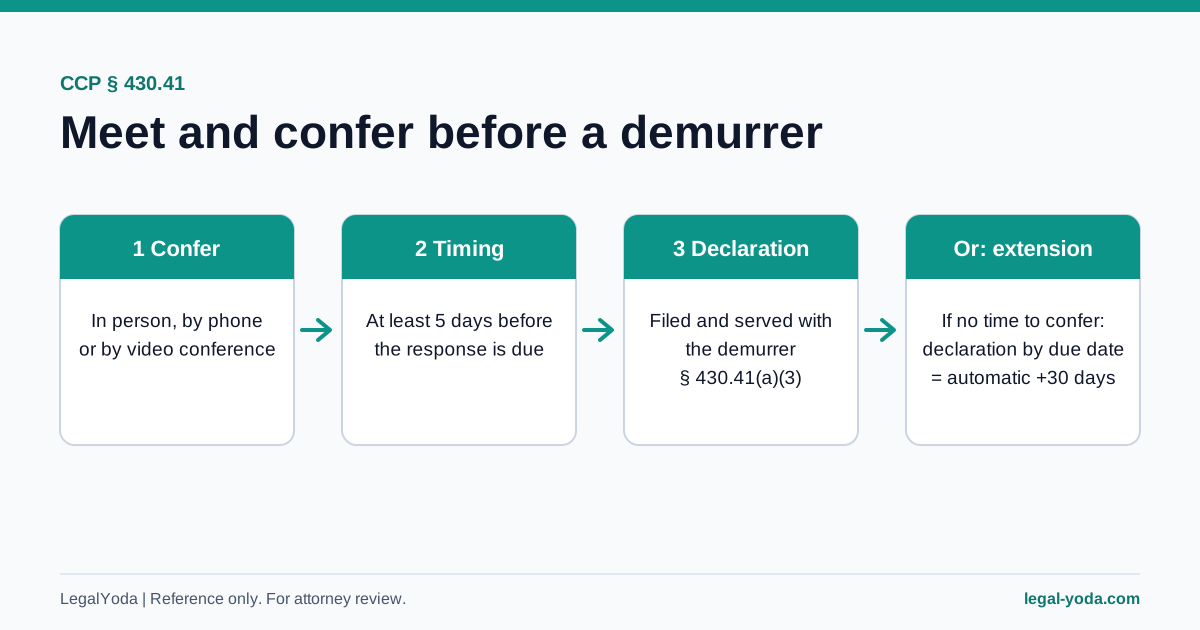
Before a demurrer to a California complaint can be filed, the demurring party must meet and confer. The requirement is in CCP § 430.41, which the Legislature amended effective January 1, 2024. This article sets out what the cached text of the statute requires, what the declaration must say, how the automatic 30-day extension works, and the limits the statute places on the consequences of an inadequate conference.
The demurrer meet and confer requirement under CCP § 430.41
Section 430.41(a) provides that before filing a demurrer, the demurring party shall meet and confer in person, by telephone, or by video conference with the party who filed the pleading that is subject to demurrer. The purpose stated in the statute is to determine whether an agreement can be reached that would resolve the objections to be raised in the demurrer.
The requirement renews when the pleading changes. If an amended complaint, cross-complaint, or answer is filed, the responding party shall meet and confer again with the party who filed the amended pleading before filing a demurrer to the amended pleading. An earlier conference on the original pleading does not carry over.
The statute lists civil actions to which it does not apply, including an action in which a party not represented by counsel is incarcerated in a correctional institution, and a proceeding in forcible entry, forcible detainer, or unlawful detainer (CCP § 430.41(d)).
What each side must bring to the conference
Subdivision (a)(1) puts specific obligations on both sides. The demurring party shall identify all of the specific causes of action that it believes are subject to demurrer and identify with legal support the basis of the deficiencies. The party who filed the complaint, cross-complaint, or answer shall provide legal support for its position that the pleading is legally sufficient or, in the alternative, how the pleading could be amended to cure any legal insufficiency.
A conference that consists of a general call to ask whether the other side will amend is unlikely to track that language. A written outline of each cause of action and the ground under CCP § 430.10, sent before the call, gives both sides something concrete to discuss and gives the declaration a record to describe.
Timing: at least 5 days before the responsive pleading is due
Under § 430.41(a)(2) the parties shall meet and confer at least 5 days before the date the responsive pleading is due. For an initial complaint, that due date comes from CCP § 430.40(a), which allows 30 days after service. The statute speaks of the date the responsive pleading is due, so any stipulated extension that moves the due date should move the conference deadline with it. Confirm how a stipulated or ordered extension affects the date before relying on it.
Because the statute counts back from the due date, the conference date is a calendar item of its own. It should be entered at the same time as the demurrer due date, not after the first attempt to reach opposing counsel fails.
The automatic 30-day extension and its declaration
If the parties are not able to meet and confer at least 5 days before the responsive pleading is due, subdivision (a)(2) grants the demurring party an automatic 30-day extension of time within which to file a responsive pleading. To obtain it, the demurring party files and serves, on or before the date on which a demurrer would be due, a declaration stating under penalty of perjury that a good faith attempt to meet and confer was made and explaining the reasons why the parties could not meet and confer.
The statute adds three details. The 30-day extension commences from the date the responsive pleading was previously due. The demurring party is not subject to default during the extension. And any further extensions shall be obtained by court order on a showing of good cause.
- The declaration must be filed and served on or before the original due date.
- It must be made under penalty of perjury.
- It must state that a good faith attempt was made and explain why the conference could not happen.
- A second extension is not automatic; it needs a court order.
The declaration filed with the demurrer
Subdivision (a)(3) requires the demurring party to file and serve with the demurrer a declaration stating one of two things. The first option is the means by which the demurring party met and conferred with the party who filed the pleading subject to demurrer, and that the parties did not reach an agreement resolving the objections raised in the demurrer. The second option is that the party who filed the pleading failed to respond to the meet and confer request or otherwise failed to meet and confer in good faith.
The declaration should be factual: the date, the participants, the method, and what was discussed. It should not argue the merits of the demurrer. The choice between the two statutory options depends on what actually happened, and declarants should confirm each fact before signing.
What an inadequate conference does and does not do
Subdivision (a)(4) states that a determination by the court that the meet and confer process was insufficient shall not be grounds to overrule or sustain a demurrer. That limits one consequence, but it does not make the requirement optional. The statute still says the demurring party shall meet and confer, and a court may have local practices for responding to a missing or defective declaration. Counsel should confirm those practices for the assigned department.
Related provisions in the same section
Subdivision (b) bars a party demurring to an amended pleading from demurring to any portion of it on grounds that could have been raised by demurrer to the earlier version, after a demurrer to the earlier version was sustained. Subdivision (c) allows the court to order a conference of the parties before an amended pleading or a demurrer to it is filed, and says the time to file a demurrer does not begin until the conference has concluded.
Subdivision (e) limits amendments in response to a demurrer before the case is at issue, absent an offer as to additional facts showing a reasonable possibility of cure. Subdivision (g) preserves the demurring party's right to appeal after final judgment where a demurrer is overruled as to a cause of action that is not further amended. The article on leave to amend covers these in more detail.
Meet and confer checklist
A short list of items to confirm for each demurrer:
- The date the responsive pleading is due, and the conference deadline at least 5 days before it.
- A written list of causes of action and the legal support for each claimed deficiency.
- The method used: in person, telephone, or video conference.
- Whether the extension declaration is needed, and the date by which it must be filed and served.
- Which of the two declaration options in subdivision (a)(3) matches the facts.
Related articles
- California Demurrer Deadline and ExtensionsRead article
- Demurrer Leave to Amend in CaliforniaRead article
- How to Write a Demurrer in CaliforniaRead article
- Unlawful Detainer Demurrer in CaliforniaRead article
- Demurrer Meet and Confer Letter and DeclarationRead article
- CCP 430.10(a): No Jurisdiction of the SubjectRead article
- CCP 430.10(e): Facts Not SufficientRead article
Reference only. Not legal advice. LegalYoda is a document preparation service, not a law firm.