The plaintiff who is served with a demurrer does not get a fresh 30 days. The opposition is due on a date counted backward from the hearing, and the hearing date was chosen by the other side. This article sets out the opposition to demurrer deadline as the cached statutes and rules read, shows how to count it, and marks the points that depend on the current code, a court order or a local rule. It is reference material for licensed attorneys.
Opposition to demurrer deadline in California: nine court days
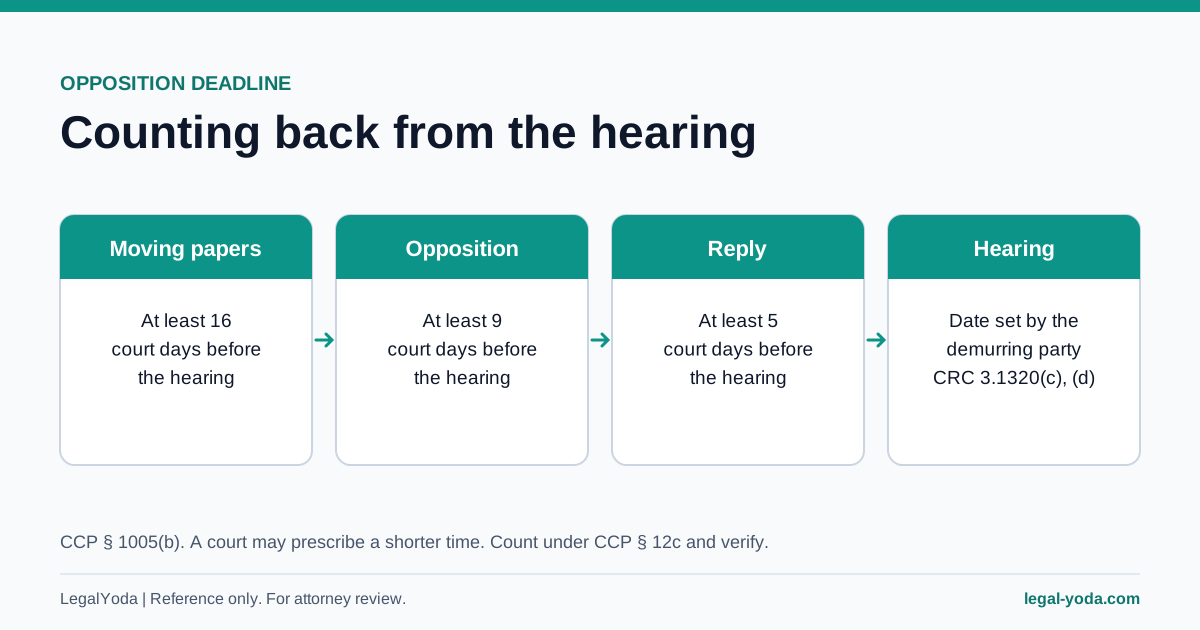
CCP § 1005(b) sets the schedule for a noticed motion. Moving and supporting papers are served and filed at least 16 court days before the hearing. All papers opposing the motion are filed with the court, and a copy is served on each party, at least nine court days before the hearing. Reply papers follow at least five court days before the hearing. A demurrer is noticed under CRC 3.1320(c) in accordance with CCP § 1005, so the same schedule governs it.
The rule opens with the words unless otherwise ordered or specifically provided by law, and it adds that the court, or a judge, may prescribe a shorter time. The nine-court-day date is therefore a default. Read the notice of hearing and any scheduling order before treating it as final.
Where the hearing date, and so the deadline, comes from
The party that files the demurrer sets the hearing. CRC 3.1320(d) says demurrers must be set for hearing not more than 35 days after the demurrer is filed, or on the first date available to the court after that. For good cause the court may order the hearing held earlier or later on notice the court prescribes.
The opposition is due nine court days out and the moving papers are due at least 16 court days out, so when a demurrer is served on the minimum notice the opposing party can have as few as seven court days between service and the opposition date. Service by mail lengthens the 16-day notice by five calendar days when mailed within California, but the cached text of CCP § 1005(b) states that CCP § 1013 does not apply to papers opposing the motion, so mail does not lengthen the opposition date itself.
How to count back from the hearing
CCP § 12c(a) says that where a law requires an act to be performed no later than a specified number of days before a hearing date, the last day is found by counting backward from the hearing date, excluding the day of the hearing as provided by CCP § 12. The cache does not define the term court days. CCP § 12a treats Saturdays and the holidays listed in CCP § 135 as holidays when a period ends on one, so a count that crosses a weekend or a judicial holiday should skip those days. Confirm the result against the court’s own calendar, since a court can close on days that are not statewide holidays.
A short method: write down the hearing date, move back one court day at a time nine times, and put the result on the calendar with the filing date and the service date as separate entries. Run the count again from any continued hearing date, because every date in the chain moves when the hearing moves.
Filing and serving the opposition
Section 1005(b) requires both filing and service by the nine-court-day date. Subdivision (c) adds a delivery rule: opposition papers must be served by personal delivery, facsimile transmission, express mail or other means consistent with CCP §§ 1010, 1011, 1012 and 1013 and reasonably calculated to ensure delivery to the other party not later than the close of the next business day after the papers are filed. Ordinary mail on the last day does not fit that description.
Electronic service is a separate question. CCP § 1010.6(a)(3)(B) extends periods after electronic service by two court days, subject to listed exceptions. Whether that extension applies to opposition papers, given the text of § 1005(b), is not answered by the cache. Do not add days on an assumption; verify the current statute and any court order.
What the opposition has to contain
CRC 3.1113(a) requires a party filing a motion to serve and file a supporting memorandum. The cached rule speaks to the moving party’s missing memorandum, and it does not say what happens to an opposition filed without one, so verify how the assigned department treats that.
Under CRC 3.1113(d), no responding memorandum may exceed 15 pages, not counting the caption page, exhibits, declarations, the tables or the proof of service. A memorandum over 10 pages needs a table of contents and a table of authorities, and one over 15 pages needs an opening summary of argument (CRC 3.1113(f)). Under CRC 3.1113(g) an oversized memorandum is filed and considered in the same manner as a late-filed paper.
The meet and confer record matters to the opposition too
CCP § 430.41(a)(1) requires the party who filed the complaint to provide legal support for its position that the pleading is legally sufficient or, in the alternative, how it could be amended to cure any legal insufficiency. The demurring party must file a declaration describing the conference or the failure to confer (CCP § 430.41(a)(3)). A court determination that the meet and confer was insufficient is not a ground to overrule or sustain the demurrer (CCP § 430.41(a)(4)). The record is worth having in hand for the opposition, but the statute says it does not decide the motion.
Local rules can change the practical date
Counties add timing and procedure on top of the statute, including how tentative rulings are handled and how hearing dates are reserved. The county pages linked below list the rules stored for each covered county and say what to confirm on the court’s website. A county outside that set is not covered here and has to be checked directly.
Calendar checklist for the opposing party
Entries to make once the demurrer is served:
- The hearing date from the notice, and the date the demurrer was filed (CRC 3.1320(d)).
- Nine court days before the hearing: file the opposition, counted back under CCP § 12c.
- The next business day after filing: service under CCP § 1005(c).
- Five court days before the hearing: the date reply papers are due, so the opposition can be read against it.
- Any shorter time ordered by the court and any local rule on tentative rulings or date reservation.
Related articles
Reference only. Not legal advice. LegalYoda is a document preparation service, not a law firm.