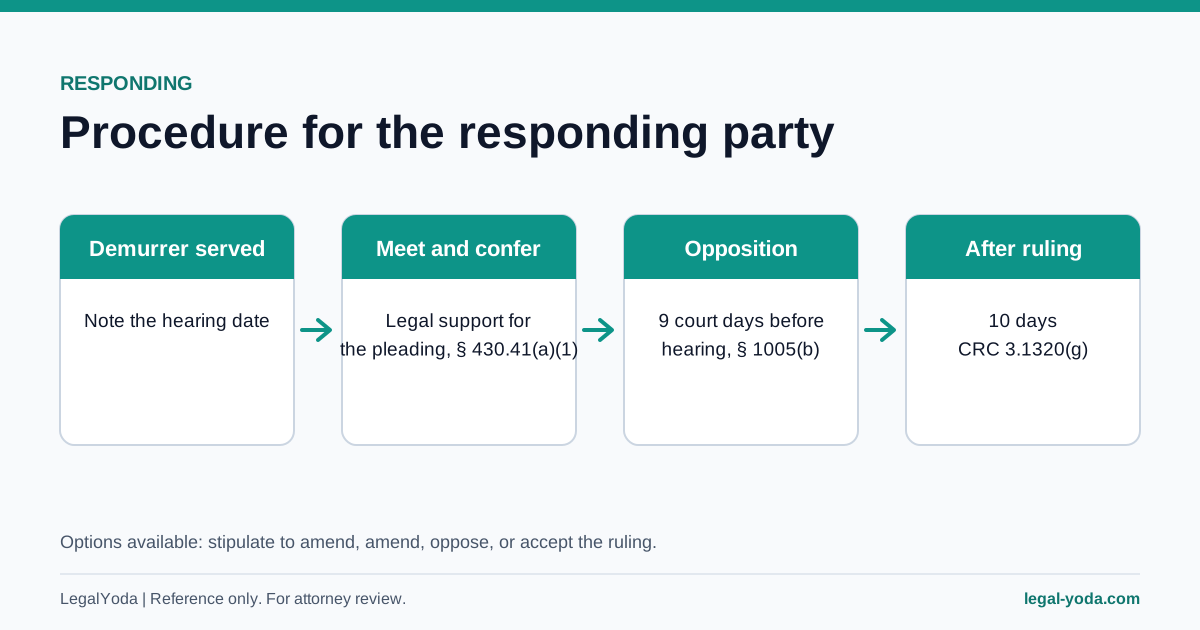
This article is written from the side of the party whose pleading has been demurred to. It covers procedure only: what the statutes and rules require, which dates apply, and what choices the procedure leaves open. It does not evaluate any complaint or say which choice fits a case. Points that depend on case law or on the court’s local rules are marked for verification.
First steps after a demurrer is served
Start with the notice of hearing. CRC 3.1320(c) requires a demurrer to come with a notice of hearing that specifies a date, and CRC 3.1320(d) says the demurrer must be set not more than 35 days after filing or on the first date available to the court afterward. The hearing date drives the opposition date.
Then check what the demurrer attacks. Under CRC 3.1320(a), each ground must be in a separate paragraph that states whether it applies to the entire pleading or to specified causes of action. The response can be built cause of action by cause of action from that structure.
The meet and confer duty runs both ways
CCP § 430.41(a) requires the demurring party to meet and confer before filing. As part of the process, the demurring party must identify all the specific causes of action it believes are subject to demurrer and identify with legal support the basis of the deficiencies. Under subdivision (a)(1), the party who filed the pleading must provide legal support for its position that the pleading is legally sufficient or, in the alternative, how the pleading could be amended to cure any insufficiency.
Subdivision (a)(4) says a court determination that the process was insufficient is not a ground to overrule or sustain the demurrer. The conference is therefore a chance to resolve the objections, not a way to defeat the demurrer on procedure alone. The demurrer must be accompanied by a declaration under subdivision (a)(3) that either describes how the conference took place or states that the responding party did not respond or did not meet and confer in good faith.
Options available
The procedure leaves the responding party several paths, and they are not mutually exclusive in every case. This article lists them without ranking them:
- Agree, in the meet and confer or by stipulation, to amend the pleading. Whether a stipulation needs court approval is a question for the court’s rules.
- File an amended pleading. CCP § 472 governs amendment without leave of court and is not in the cache, so read it directly.
- File an opposition to the demurrer and appear at the hearing.
- Do neither, and accept the ruling. CRC 3.1320(g) and (j) then control the next steps.
The opposition: dates and service
CCP § 1005(b) requires papers opposing a noticed motion to be filed with the court, and a copy served on each party, at least nine court days before the hearing. Reply papers are due five court days before. Subdivision (c) requires the opposition to be served by a means reasonably calculated to ensure delivery not later than the close of the next business day after it is filed.
CRC 3.1113(d) limits an opposition memorandum to 15 pages, not counting the caption page, exhibits, declarations, tables and proof of service. A memorandum over 10 pages needs a table of contents and a table of authorities under subdivision (f). The date and page rules are covered in detail in the articles on demurrer opposition deadlines and on the page limit.
Leave to amend and the offer of additional facts
CCP § 430.41(e)(1) provides that in response to a demurrer and before the case is at issue, a complaint or cross-complaint may not be amended more than three times absent an offer to the trial court as to such additional facts to be pleaded that there is a reasonable possibility the defect can be cured. The cached text does not say where or how such an offer is made, and the standard a court applies to leave to amend comes from case law that is not in the cache.
The article on demurrers sustained without leave to amend lists the one case already quoted in the repository on this point. It must be verified before it is cited.
After the ruling
CRC 3.1320(g) deems leave to answer or amend within 10 days granted following a ruling, unless the court orders otherwise. If the demurrer is sustained with leave to amend, CCP § 430.41(c) lets the court order a conference of the parties before an amended pleading or a further demurrer may be filed. An amended pleading starts a new round: the demurring party must meet and confer again before demurring to it under subdivision (a), and subdivision (b) limits the grounds available to it.
If the demurrer is overruled, CRC 3.1320(j) gives the defendant 10 days to answer unless the court orders otherwise.
Local practice
Tentative rulings are the main local variable. Some courts post a tentative ruling the day before the hearing and make it the order unless a party gives notice of an intent to appear by a stated time. The county pages on this site list the verified rules for sixteen counties, with their citations. For any other county, read the local rules and the department’s procedures on the court’s website. Hearing-date reservation, courtesy copies and the way oral argument is requested all vary, and a missed local step can matter as much as a missed statutory date.
Related articles
Reference only. Not legal advice. LegalYoda is a document preparation service, not a law firm.