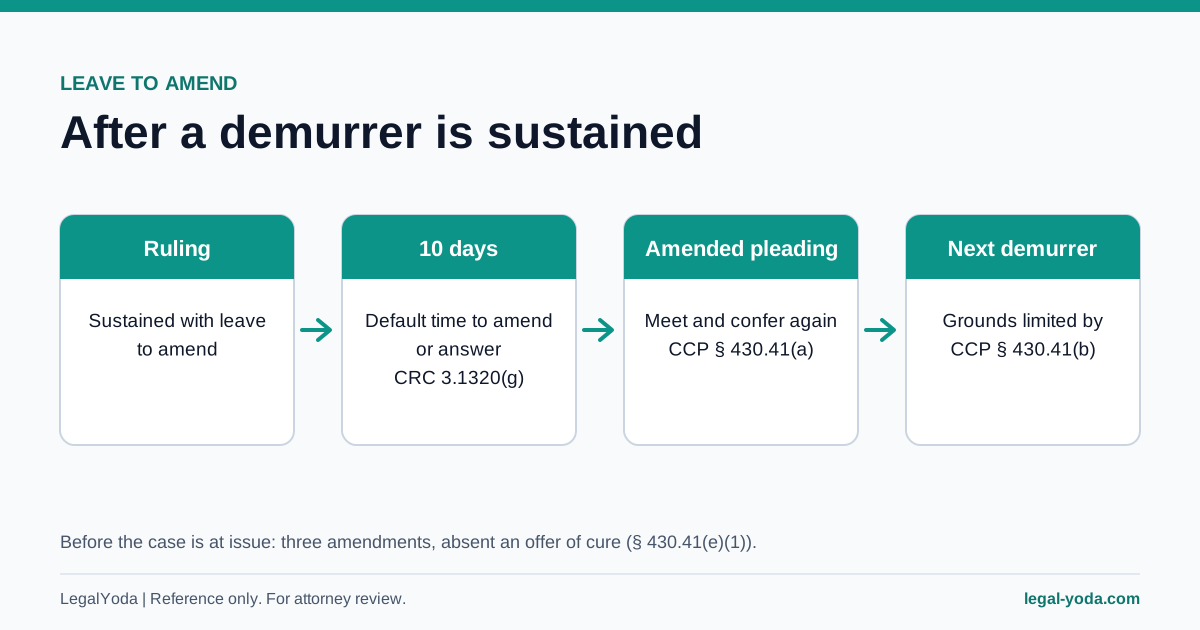
A ruling on a demurrer rarely ends the pleading stage. In California the court usually decides whether the plaintiff may try again, and statutes and rules then control how long the amendment takes and what the defendant can do next. This article walks through demurrer leave to amend using the cached text of CCP § 430.41 and CRC 3.1320, and flags the points that depend on case law the repo does not cache.
Demurrer leave to amend in California: the possible rulings
A court that rules on a demurrer can overrule it, sustain it with leave to amend, or sustain it without leave to amend. CRC 3.1320(j) attaches a time to each: unless otherwise ordered, the defendant has 10 days to answer or otherwise plead to the complaint or the remaining causes of action following the overruling of the demurrer, the expiration of the time to amend if the demurrer was sustained with leave to amend, or the sustaining of the demurrer without leave to amend.
The practical consequence is that the order itself fixes the next step. An attorney should read the written ruling, not just the tentative or the minute order, because the rule begins with the phrase unless otherwise ordered.
The 10-day default under CRC 3.1320(g)
CRC 3.1320(g) provides that following a ruling on a demurrer, unless otherwise ordered, leave to answer or amend within 10 days is deemed granted, except for actions in forcible entry, forcible detainer, or unlawful detainer, in which case 5 calendar days is deemed granted. The cached rule text does not say from what event the 10 days run, so confirm that in the current rule and the order.
The rule is a default. A court may set a longer or shorter time in the order, and a different schedule may be set by the order. If the order is silent, the default applies. Each of those possibilities should be calendared from the order itself, not from memory.
The standard for granting leave: verify in case law
The cached statutes do not state the standard a court applies in deciding whether to grant leave to amend, and this article does not state one. That standard comes from case law, and it should be taken from a current, verified source before it is argued. The only statutory language on the subject in the cache is in CCP § 430.41(e)(1), discussed below, which speaks of an offer to the trial court as to additional facts to be pleaded showing a reasonable possibility that the defect can be cured.
For the party opposing a demurrer, the cached statute at least points to the kind of proffer that matters: what additional facts would be pleaded. For the party demurring, the same language is a reason to anticipate that showing in the memorandum rather than leaving it to reply.
The three-amendment limit in CCP § 430.41(e)
Subdivision (e)(1) of CCP § 430.41 states that in response to a demurrer and prior to the case being at issue, a complaint or cross-complaint shall not be amended more than three times, absent an offer to the trial court as to such additional facts to be pleaded that there is a reasonable possibility the defect can be cured to state a cause of action. The three-amendment limit does not include an amendment made without leave of court under CCP § 472, provided the amendment is made before a demurrer to the original complaint or cross-complaint is filed.
Subdivision (e)(2) says nothing in the section affects the rights of a party to amend its pleading or respond to an amended pleading after the case is at issue. CCP § 472 is not in the repo's cache, so the amendment-as-of-right rule it contains should be read directly.
Meet and confer again after an amended pleading
If an amended complaint, cross-complaint, or answer is filed, the responding party must meet and confer again with the party who filed the amended pleading before filing a demurrer to it (CCP § 430.41(a)). The five-day timing and the declaration requirements in subdivision (a) apply again, as does the automatic 30-day extension if the conference cannot take place in time.
CCP § 430.41(c) adds that if a court sustains a demurrer to one or more causes of action and grants leave to amend, it may order a conference of the parties before an amended pleading or a demurrer to it may be filed. If a conference is held, the court shall not preclude a party from filing a demurrer, and the time to file a demurrer shall not begin until after the conference has concluded.
Limits on a later demurrer
Subdivision (b) bars a party who demurs to a pleading amended after a demurrer was sustained from demurring to any portion of the amended pleading on grounds that could have been raised by demurrer to the earlier version. The consequence for drafting is plain: the first demurrer should raise every ground that is available, because the statute limits what can be raised the second time.
The same subdivision refers to grounds that could have been raised, not grounds that were raised. A ground left out of the first demurrer is still within the bar. Counsel should check how courts have applied the bar to new matter alleged in an amended pleading, since the cached statute does not address that.
If the demurrer is overruled
CCP § 430.41(g) provides that if a demurrer is overruled as to a cause of action and that cause of action is not further amended, the demurring party preserves its right to appeal after final judgment without filing a further demurrer. Subdivision (f) adds that nothing in the section affects appellate review or the rights of a party under CCP § 430.80, which is not in the cache and should be read in the current code.
Checklist after a ruling
Items to calendar and confirm once the court rules:
- What the order says about leave to amend and the time allowed, and whether it departs from the 10-day default.
- Which causes of action remain and the date to answer under CRC 3.1320(j).
- How many amendments have been filed in response to demurrers so far.
- Whether the court ordered a conference under CCP § 430.41(c).
- Which grounds the next demurrer, if any, may raise under CCP § 430.41(b).
Related articles
- California Demurrer Meet and Confer RequirementRead article
- Demurrer for Failure to State a Cause of ActionRead article
- California Demurrer Deadline and ExtensionsRead article
- Demurrer Sustained Without Leave to AmendRead article
- Demurrer to a First Amended Complaint in CARead article
- Proposed Order for a Demurrer in CaliforniaRead article
Reference only. Not legal advice. LegalYoda is a document preparation service, not a law firm.