A ruling that sustains a demurrer without leave to amend ends the pleading stage for the challenged causes of action unless the plaintiff can show a way to cure them. The cached rules say little about the standard for that call, so this article sticks to what the statutes and rules do say and flags the case-law points that must be checked. It reuses only one case already quoted in this repository, and that case must be read in the reporter before anyone cites it.
The three outcomes of a demurrer ruling
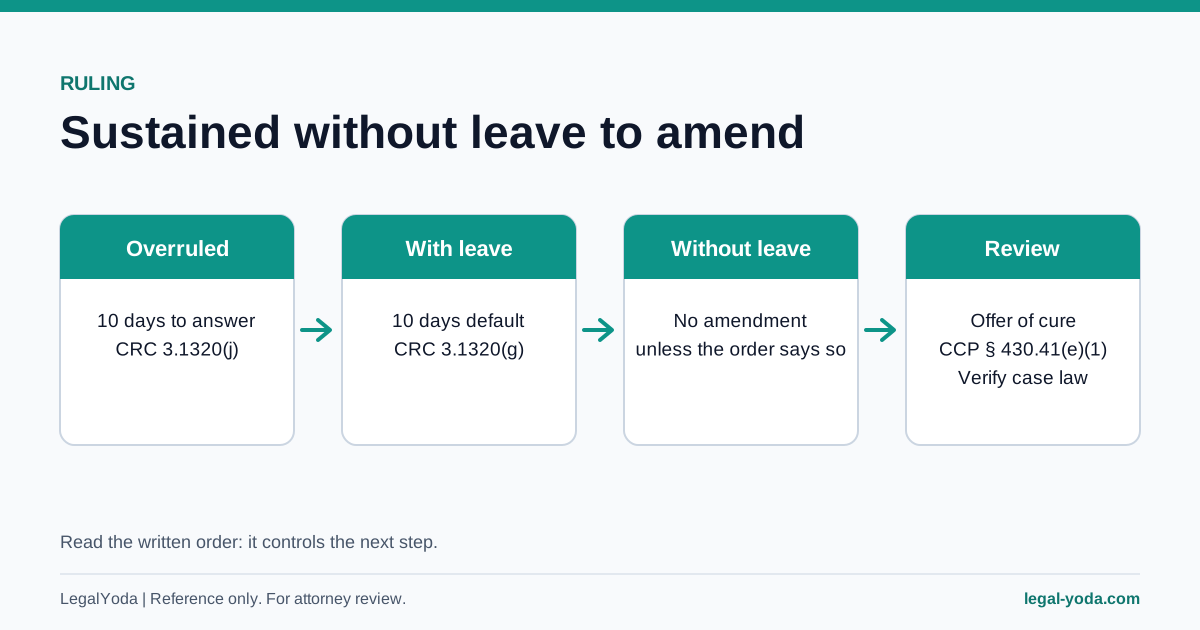
A court can overrule a demurrer, sustain it with leave to amend, or sustain it without leave to amend. CRC 3.1320(j) attaches a response time to each outcome. Unless otherwise ordered, the defendant has 10 days to answer or otherwise plead after the overruling of the demurrer, after the time to amend expires if the demurrer was sustained with leave, or after the sustaining of the demurrer without leave to amend.
The third branch matters most for this article. If the court sustains without leave on every cause of action, there is nothing left to plead against. If it sustains without leave on some causes of action only, the remaining causes of action go forward and CRC 3.1320(j) gives the defendant 10 days to respond to them, unless the order says otherwise.
The default rule and why the order controls
CRC 3.1320(g) provides that following a ruling on a demurrer, unless otherwise ordered, leave to answer or amend within 10 days is deemed granted. An order sustaining a demurrer without leave to amend is an order to the contrary. The words unless otherwise ordered in the rule are the reason the written order, not the tentative ruling or the minute entry alone, has to be read.
Read the order for three things: which causes of action it reaches, whether leave is denied as to all of them or only some, and whether it sets a date for any further step. A proposed order that describes the ruling loosely can leave the status of a cause of action unclear.
The standard for denying leave: verify in case law
The cached statutes and rules do not state the test a trial court applies when it decides whether to deny leave to amend. The repository’s case-text cache includes Blank v. Kirwan (1985) 39 Cal.3d 311, 318, which says that when a demurrer is sustained without leave to amend, the reviewing court decides whether there is a reasonable possibility that the defect can be cured by amendment. If there is, denying leave was an abuse of discretion; if not, it was not. The same passage places the burden of showing that possibility on the plaintiff.
That is a description of appellate review, taken from one case. It has not been checked here against later authority, and it should be confirmed in the reporter and in current citator results before it appears in a brief. The same caution applies to any other case offered for the standard.
The offer of additional facts
CCP § 430.41(e)(1) is the statutory hook that points the same way. In response to a demurrer, and before the case is at issue, a complaint or cross-complaint may not be amended more than three times, absent an offer to the trial court as to such additional facts to be pleaded that there is a reasonable possibility the defect can be cured to state a cause of action. The limit does not count an amendment made without leave of court under CCP § 472, if made before a demurrer to the original pleading is filed.
For the plaintiff, the practical content is an offer of specific facts, made to the trial court. For the defendant, a demurrer memorandum that explains why the defect is one of law and cannot be cured by more pleading gives the court something to rule on. CCP § 472 is not in the cache and should be read directly.
After the ruling: judgment and appeal
The cache does not include the statutes on dismissal and entry of judgment after a demurrer is sustained without leave to amend, or the time limits for appeal. Those steps depend on the content of the order and on whether any causes of action remain. They are time-sensitive, and the rules should be read in the current code the day the order is received.
CCP § 430.41(g) addresses the opposite case: if a demurrer is overruled as to a cause of action and that cause of action is not further amended, the demurring party preserves its right to appeal after final judgment without filing a further demurrer. Subdivision (f) adds that nothing in the section affects appellate review or the rights of a party under CCP § 430.80, which is not in the cache.
If an earlier demurrer was already sustained
CCP § 430.41(b) bars a party who demurs to an amended pleading, after a demurrer to an earlier version was sustained, from demurring on grounds that could have been raised against the earlier version. A defendant seeking an order without leave to amend on a second round is therefore limited to grounds that were not available before, and the first demurrer should carry every ground the defendant means to use.
Subdivision (c) lets the court order a conference of the parties after sustaining a demurrer with leave to amend, before an amended pleading or a further demurrer may be filed. The time to demur does not begin until the conference has concluded.
Checklist after a ruling without leave
Items to confirm once the order is entered:
- Which causes of action the order sustains without leave and which remain.
- The 10-day response period for any remaining causes of action under CRC 3.1320(j).
- Any deadlines for judgment, dismissal and appeal, read from the current code.
- The number of amendments already filed in response to demurrers under CCP § 430.41(e).
- Whether Blank v. Kirwan or other authority has been verified before citing it.
Related articles
Reference only. Not legal advice. LegalYoda is a document preparation service, not a law firm.