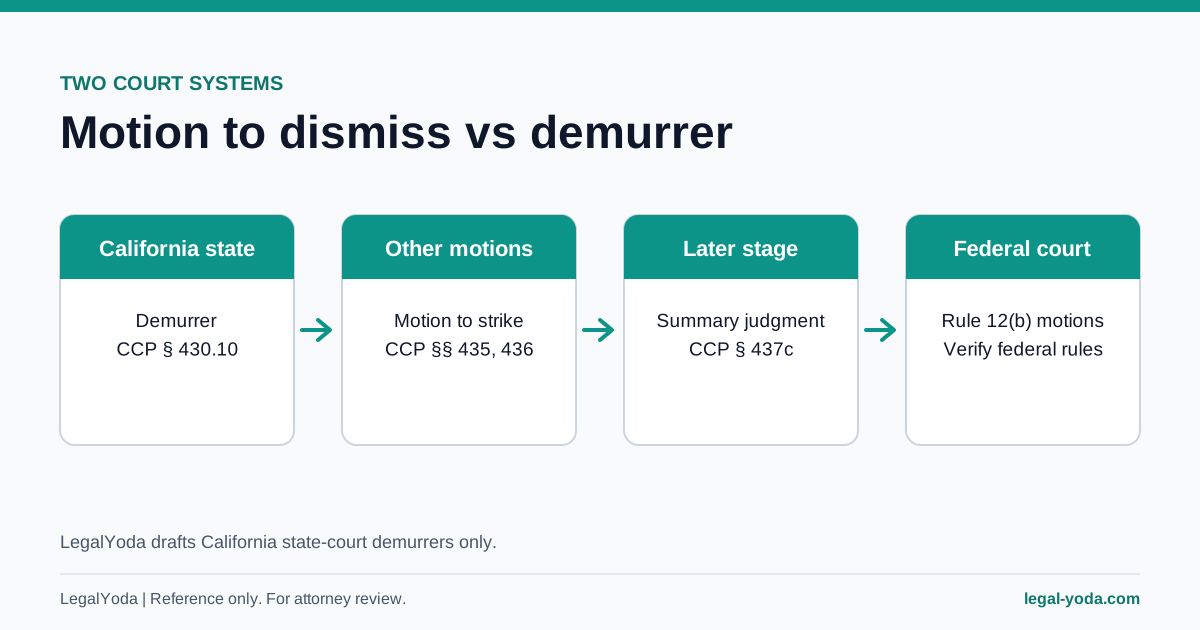
Search results for motion to dismiss mix state and federal practice. In California superior court, the usual way to challenge the legal sufficiency of a complaint is a demurrer, not a motion to dismiss. This article explains the difference at a general level, lists the other pleading challenges that the repository’s cache covers, and keeps its statement about federal practice short and marked for verification.
In California state court, the pleading challenge is a demurrer
CCP § 430.10 provides that the party against whom a complaint or cross-complaint has been filed may object, by demurrer or answer as provided in CCP § 430.30, to the pleading on any of the listed grounds. Those include lack of jurisdiction of the subject matter, lack of capacity to sue, another action pending, defect or misjoinder of parties, failure to state facts sufficient to constitute a cause of action, uncertainty, and a missing certificate where one is required.
The vocabulary of a motion to dismiss is not used in these cached sections. A defendant who wants to attack the sufficiency of a complaint at the pleading stage files a demurrer, with a notice of hearing, a memorandum and a meet and confer declaration. The article on the demurrer package lists those papers.
Timing of a demurrer
CCP § 430.40(a) allows a demurrer within 30 days after service of the complaint or cross-complaint. CCP § 430.41(a) requires a meet and confer before filing, at least five days before the responsive pleading is due, and it provides an automatic 30-day extension when the conference cannot happen in time and the right declaration is filed. CRC 3.1320(d) says a demurrer must be set for hearing not more than 35 days after filing or on the first available date afterward.
CCP § 430.30(a) allows the objection by demurrer when it appears on the face of the pleading or from a matter subject to judicial notice. When the ground does not appear on the face, subdivision (b) allows the objection to be taken by answer.
Other California pleading challenges
A demurrer is one of several tools, and each has its own statute. A motion to strike is governed by CCP § 435, which allows a party to move to strike the whole or any part of a pleading within the time allowed to respond, and CCP § 436, which lets the court strike irrelevant, false or improper matter. The article on demurrer vs motion to strike compares the two.
Summary judgment and summary adjudication are governed by CCP § 437c and come later in a case, on evidence. The cache also holds CCP § 425.16, the anti-SLAPP statute, which is a separate special motion. None of these is called a motion to dismiss in the cached text, and this article does not map them onto that label.
Why the two terms get mixed up
The phrase motion to dismiss is used in federal practice and in other states, and search results for California queries mix those sources in. The cached California statutes organize the pleading stage around the demurrer, the answer and the motion to strike, and they speak of objecting to a pleading rather than moving to dismiss it.
The cache does not say how a superior court treats a paper titled motion to dismiss, and this article does not predict it. The statutes name the demurrer, so that is the procedure to check against the court’s local rules for form and notice. Those rules, not this article, decide how a hearing date is obtained and how tentative rulings work in the county where the case is pending.
Where dismissal fits
Dismissal can follow a demurrer. When a demurrer is sustained without leave to amend, the case or the affected causes of action may end in a judgment or order of dismissal. The statutes that govern dismissals and judgments after a demurrer are not in the cache and are not described here. The ruling itself comes under CRC 3.1320(g) and (j), which deal with leave to answer or amend and the time to respond.
The point for search purposes is that in a California superior court pleading challenge, dismissal is the result of a ruling, not the name of the motion that asks for it. A party who sees a dismissal order after a demurrer should read the order and the statutes it cites.
Federal court: a different procedure
Federal civil actions are governed by the Federal Rules of Civil Procedure, not by the California Code of Civil Procedure. Federal practice uses a motion under Rule 12(b) of those rules, including a motion for failure to state a claim under Rule 12(b)(6), where a California state court would use a demurrer. The federal rules are not in this site’s cache, and their text, deadlines and local rules should be read directly before a federal filing.
The difference matters when a case can be filed or removed between systems, because the procedure changes with the court. LegalYoda’s demurrer drafting covers California state-court demurrers only.
What to check before choosing a filing
Questions to settle before drafting:
- Which court the case is in, and therefore which rules apply.
- Whether the defect appears on the face of the pleading, per CCP § 430.30.
- The response date for the complaint under CCP § 430.40(a) and any extension under CCP § 430.41.
- Whether a motion to strike under CCP § 435 is also being considered, and how it affects timing.
- The local rules for the county, including how hearing dates are reserved.
Related articles
Reference only. Not legal advice. LegalYoda is a document preparation service, not a law firm.