The grounds for demurrer in California are set out in a single statute, CCP § 430.10, and the list is short. Each ground has its own subdivision, and a demurrer must tie every objection to one of them. This article lists the grounds as the cached statute states them, explains the face-of-the-pleading rule, and notes how the grounds are separated in the demurrer itself. It is reference material for attorneys.
The grounds for demurrer in California under CCP § 430.10
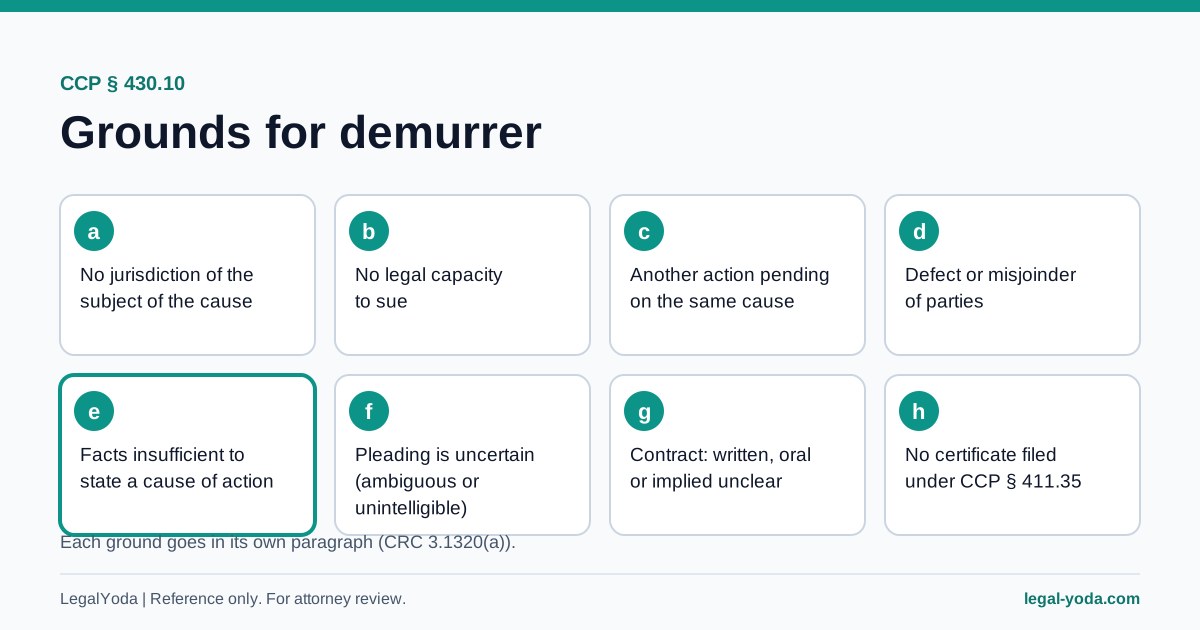
Section 430.10 allows the party against whom a complaint or cross-complaint has been filed to object, by demurrer or answer as provided in CCP § 430.30, to the pleading on any one or more of eight grounds. They are listed below in the statute's own order.
- (a) The court has no jurisdiction of the subject of the cause of action alleged in the pleading.
- (b) The person who filed the pleading does not have the legal capacity to sue.
- (c) There is another action pending between the same parties on the same cause of action.
- (d) There is a defect or misjoinder of parties.
- (e) The pleading does not state facts sufficient to constitute a cause of action.
- (f) The pleading is uncertain, which includes ambiguous and unintelligible.
- (g) In an action founded upon a contract, it cannot be ascertained from the pleading whether the contract is written, oral, or implied by conduct.
- (h) No certificate was filed as required by CCP § 411.35.
The face-of-the-pleading rule
CCP § 430.30(a) provides that when any ground for objection to a complaint, cross-complaint, or answer appears on the face of the pleading, or from any matter of which the court is required to or may take judicial notice, the objection on that ground may be taken by demurrer. Subdivision (b) adds that when a ground does not appear on the face of the pleading, the objection to a complaint or cross-complaint may be taken by answer.
This is why many demurrer grounds depend on what the complaint itself says. A ground such as another action pending or lack of capacity may or may not be visible on the face of a particular complaint. If it is not visible and not judicially noticeable, the statute points to an answer instead. Whether a particular matter can be judicially noticed is a separate question that the cached statutes do not answer, so counsel should confirm the authority for any judicial notice request.
Ground (e): failure to state facts sufficient to constitute a cause of action
Subdivision (e) is the ground that tests whether the pleaded facts support each cause of action. The existing LegalYoda demurrer guide reproduces a rule from Aubry v. Tri-City Hospital Dist. (1992) 2 Cal.4th 962, 967, that it is error to sustain a demurrer when the plaintiff has stated a cause of action under any possible legal theory. A separate article on failure to state a cause of action covers this ground in more detail.
Ground (f): uncertainty
Uncertainty under subdivision (f) includes ambiguous and unintelligible pleading. The guide cites Khoury v. Maly's of California, Inc. (1993) 14 Cal.App.4th 612, 616, for the proposition that a demurrer for uncertainty is strictly construed. Because that standard affects how much weight an uncertainty paragraph carries, counsel should read the current authority before including one.
Grounds (g) and (h): contract type and the certificate
Subdivision (g) applies to an action founded upon a contract and turns on whether the pleading shows whether the contract is written, oral, or implied by conduct. Subdivision (h) refers to the certificate required by CCP § 411.35. That section, as summarized in the existing demurrer guide, applies to actions arising out of the professional negligence of a licensed architect, professional engineer, or land surveyor. Read the current text of § 411.35 before using subdivision (h).
Grounds for demurring to an answer
A different statute covers demurrers by the plaintiff. CCP § 430.20 lets a party against whom an answer has been filed demur on three grounds: the answer does not state facts sufficient to constitute a defense; the answer is uncertain; or, where the answer pleads a contract, it cannot be ascertained whether the contract is written or oral. The time to demur to an answer is 10 days after service of the answer (CCP § 430.40(b)), and a demurrer may be taken to the whole answer or to any one or more of the several defenses (CCP § 430.50(b)).
How the grounds are stated in the demurrer
CRC 3.1320(a) requires each ground of demurrer to be in a separate paragraph and to state whether it applies to the entire complaint, cross-complaint, or answer, or to specified causes of action or defenses. CRC 3.1320(b) provides that a demurrer to a cause of action may be filed without answering other causes of action, and CCP § 430.50(a) allows a demurrer to the whole complaint or to any of its causes of action.
CRC 3.1113(a), in the cached excerpt, says the court may construe the absence of a memorandum as an admission that the motion or special demurrer is not meritorious and, in the case of a demurrer, as a waiver of all grounds not supported. The practical point is that every ground listed in the demurrer needs support in the memorandum.
A grounds checklist before drafting
For each cause of action in the complaint, an attorney can work through these questions.
- Which subdivision of CCP § 430.10 does the objection fall under?
- Does the objection appear on the face of the pleading or in judicially noticeable matter, as CCP § 430.30(a) requires?
- Is the ground stated in its own paragraph and tied to the correct cause of action under CRC 3.1320(a)?
- Does the memorandum support each ground, so none is treated as waived?
- Was the ground raised in the meet and confer under CCP § 430.41?
Related articles
- General vs Special Demurrer in CaliforniaRead article
- Demurrer for Failure to State a Cause of ActionRead article
- Demurrer vs Motion to Strike in CaliforniaRead article
- Demurrer to an Answer in CaliforniaRead article
- Demurrer to a Breach of Contract Claim in CARead article
- What Is a Demurrer in California?Read article
- CCP 430.10(a): No Jurisdiction of the SubjectRead article
- CCP 430.10(b): Legal Capacity to SueRead article
- CCP 430.10(c): Another Action PendingRead article
- CCP 430.10(d): Defect or Misjoinder of PartiesRead article
- CCP 430.10(e): Facts Not SufficientRead article
- CCP 430.10(f): Uncertain Pleading DefinedRead article
- CCP 430.10(g): Written, Oral or ImpliedRead article
Reference only. Not legal advice. LegalYoda is a document preparation service, not a law firm.