Defense counsel responding to a California complaint may have both tools available: a demurrer and a motion to strike. They are different motions with different grounds, and they may be filed together. This article compares them using the text of the statutes and rules, so an attorney can see which provision supports which objection. It is reference material and it describes what the codes say, not which motion to file.
Demurrer vs motion to strike in California: what each does
A demurrer is an objection to a pleading on one of the grounds listed in CCP § 430.10. Those grounds include lack of subject matter jurisdiction, lack of legal capacity to sue, another action pending, defect or misjoinder of parties, failure to state facts sufficient to constitute a cause of action, uncertainty, the unascertainable-contract ground, and the missing certificate under CCP § 411.35. A ground may be raised by demurrer when it appears on the face of the pleading or from a matter of which the court must or may take judicial notice (CCP § 430.30(a)).
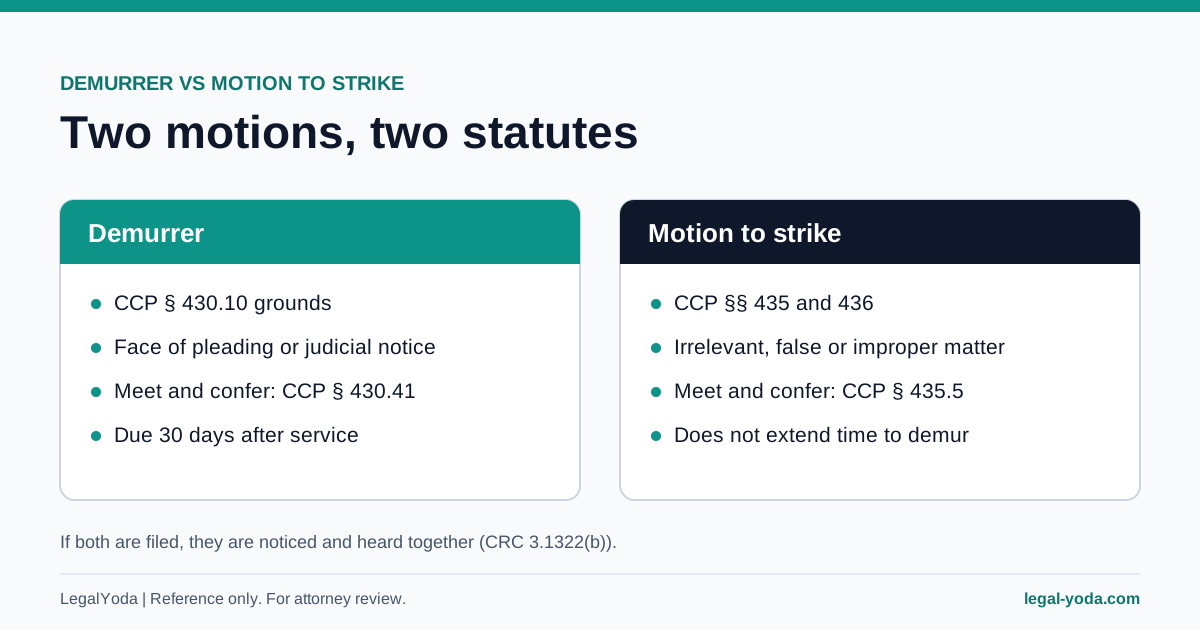
A motion to strike is governed by CCP §§ 435 and 436. Under § 436 the court may strike out any irrelevant, false, or improper matter inserted in a pleading, and may strike all or any part of a pleading not drawn or filed in conformity with the laws of this state, a court rule, or an order of the court. In short, a demurrer asks whether the pleading is legally sufficient on a listed ground, while a motion to strike targets specified matter or non-conforming portions of the pleading.
Side-by-side comparison
The following points come from the cached text of the cited authorities.
- Statutory basis: CCP § 430.10 for a demurrer; CCP §§ 435 and 436 for a motion to strike.
- Target: a demurrer may be taken to the whole complaint or to any of the causes of action stated in it (CCP § 430.50(a)); a motion to strike may be directed to the whole or any part of a pleading (CCP § 435(b)(1)).
- Time to file: a demurrer is due within 30 days after service of the complaint (CCP § 430.40(a)); a motion to strike is made within the time allowed to respond to the pleading (CCP § 435(b)(1)).
- Meet and confer: CCP § 430.41 applies before a demurrer; CCP § 435.5 applies before a motion to strike.
- Declaration: each requires a declaration filed and served with the motion describing the meet and confer.
Meet and confer applies to both motions
CCP § 430.41(a) requires the demurring party to meet and confer in person, by telephone, or by video conference before filing, and CCP § 435.5(a) imposes a parallel requirement before a motion to strike. Both statutes call for the conference at least 5 days before the date the responsive filing is due, and both provide an automatic 30-day extension where a declaration under penalty of perjury explains why the conference could not take place in time.
Each statute also says that a court determination that the meet and confer was insufficient is not a ground to overrule or sustain the demurrer (CCP § 430.41(a)(4)), or to grant or deny the motion to strike (CCP § 435.5(a)(4)). Some of the details differ between the two sections, so read § 435.5 in full rather than treating it as a copy of § 430.41. The cached text of § 435.5 is an excerpt, which is another reason to read the current section.
Filing both together: hearing and notice rules
CRC 3.1322(b) provides that a notice of motion to strike must be given within the time allowed to plead and, if a demurrer is interposed, concurrently with it, and must be noticed for hearing and heard at the same time as the demurrer. CCP § 435(b)(3) says the same thing about a notice of motion to strike a demurrer: the hearing is set concurrently with the hearing on the demurrer.
CRC 3.1322(a) adds a drafting requirement. A notice of motion to strike a portion of a pleading must quote in full the portions sought to be stricken, except where the motion is to strike an entire paragraph, cause of action, count, or defense, and specifications in the notice must be numbered consecutively. A motion to strike notice that omits the quoted language is a formatting problem that can be avoided.
How the two motions interact on timing
Two provisions in CCP § 435 are easy to confuse. Under § 435(c), if a party serves and files a notice of motion to strike without demurring, the time to answer is extended and no default may be entered against that defendant, except as provided in CCP §§ 585 and 586. Under § 435(d), filing a notice of motion to strike does not extend the time within which to demur.
The practical reading is that the two deadlines are not interchangeable. A party who wants to keep a demurrer available should calendar the 30-day demurrer date independently and should not assume a motion to strike buys more time for it. CCP §§ 585 and 586 are not in the repo's cache, so the exceptions that § 435(c) refers to should be checked in the current code.
Other options that appear in the same statutes
CCP § 430.30(b) provides that when a ground for objection does not appear on the face of the pleading, the objection may be taken by answer, and § 430.30(c) allows a party to demur and answer at the same time. Those provisions sit alongside, and do not replace, the motion to strike. A pleading may also be attacked on grounds that fall within § 436, such as non-conformity with a court rule, which a demurrer would not reach.
None of this tells an attorney which motion fits a particular complaint. That depends on the pleading, the ground, and the court, and it is a judgment for counsel.
Checklist when a demurrer and a motion to strike are both on the table
Items worth confirming before either motion is drafted:
- Which ground in CCP § 430.10 supports each demurrer paragraph, and whether it appears on the face of the pleading or from judicially noticeable matter.
- Which portions of the pleading are said to be irrelevant, false, improper, or non-conforming under CCP § 436, quoted in full where CRC 3.1322(a) requires.
- The meet and confer date, and whether the declarations under CCP §§ 430.41 and 435.5 are ready.
- That both motions are noticed for the same hearing under CRC 3.1322(b).
- The local rules and department procedures for reserving a hearing date.
Related articles
Reference only. Not legal advice. LegalYoda is a document preparation service, not a law firm.