Unlawful detainer is a summary proceeding with its own timing, and the ordinary demurrer rules bend around it. This article is a procedural overview built from the parts of the statutes and rules that the repository’s cache holds: CCP § 1161, CCP § 1167, CCP § 430.41 and CRC 3.1320. It is deliberately hedged. The cache does not hold the rest of the unlawful detainer statutes, and every point that depends on them is marked verify.
What an unlawful detainer complaint pleads
CCP § 1161 lists the situations in which a tenant of real property is guilty of unlawful detainer. The cached excerpt includes two of them. One is continuing in possession after default in the payment of rent, pursuant to the lease or agreement, and three days’ written notice, excluding Saturdays, Sundays and other judicial holidays, requiring payment. Another is continuing in possession after failing to perform other conditions or covenants, after a similar three-day written notice requiring performance or possession.
The notice that must precede the case is a common subject of a demurrer, because the complaint and its attachments show whether a notice was served and what it said. Whether a defect in the notice is a ground for a demurrer, and which ground, is a matter of case law and of the rest of § 1161, which the cache does not fully hold.
The 10 day response period in CCP § 1167
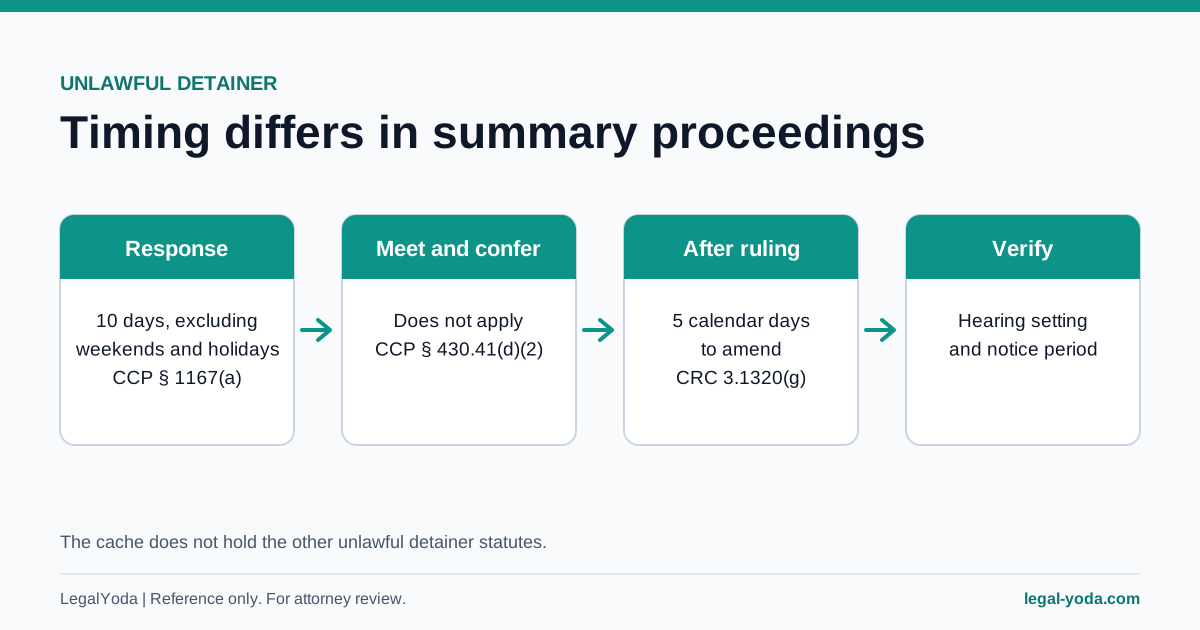
CCP § 1167(a) provides that when the defendant is served, the defendant’s response shall be filed within 10 days, excluding Saturdays and Sundays and other judicial holidays, after the complaint is served. Subdivision (b) adds an additional five court days to file a response if service is completed by mail or in person through the Secretary of State’s address confidentiality program. These are shorter and counted differently than the 30 days in CCP § 430.40(a) for a civil complaint.
The cached text uses the word response. It does not say that a demurrer is a permitted response in unlawful detainer, how it is set for hearing, or how the response period is affected when one is filed. Those answers are in other unlawful detainer statutes that are not cached. LegalYoda’s deadline table lists a 10 day response citing CCP § 1167(a), and the entry notes that the period is strict.
No meet and confer requirement
CCP § 430.41(d) lists civil actions to which the meet and confer section does not apply. Subdivision (d)(2) names a proceeding in forcible entry, forcible detainer, or unlawful detainer. Subdivision (d)(1) names an action in which a party not represented by counsel is incarcerated in a correctional institution. Because of subdivision (d)(2), the five-day timing and the declaration requirement in CCP § 430.41(a) are not applied to an unlawful detainer demurrer.
The exclusion is in the statute itself. Local practice is separate, and a court may have its own rules for unlawful detainer calendars.
Leave to amend: 5 calendar days
CRC 3.1320(g) provides that following a ruling on a demurrer, unless otherwise ordered, leave to answer or amend within 10 days is deemed granted, except for actions in forcible entry, forcible detainer, or unlawful detainer in which case 5 calendar days is deemed granted. The unlawful detainer period is therefore shorter, and it is counted in calendar days.
CRC 3.1320(j) gives a defendant 10 days to answer after the overruling of a demurrer or after the time to amend runs out. The cached text of subdivision (j) does not carve out unlawful detainer, and whether the unlawful detainer statutes set a different period is not answered by the cache. Verify the response period after a ruling in the current rule and statutes.
Hearing date and notice
The general rules say that a demurrer must be set for hearing not more than 35 days after filing under CRC 3.1320(d), and that moving papers must be served and filed at least 16 court days before the hearing under CCP § 1005(b), unless otherwise ordered or specifically provided by law. Summary proceedings often have their own timing provisions, and the cache does not hold them.
The phrase specifically provided by law in § 1005(b) is the reason to check. A summary proceeding statute that sets shorter notice would control over the 16 court days. Read the unlawful detainer statutes and the local unlawful detainer calendar rules before calendaring a hearing.
Counting the days
Two different counts appear in the cached text. CCP § 1167(a) counts the 10 days excluding Saturdays and Sundays and other judicial holidays, which is a court-day style count. CRC 3.1320(g) gives five calendar days after a ruling, which includes weekends. The same unlawful detainer case can therefore use both counts at different stages, and a calendar entry should say which one applies.
CCP § 12 excludes the first day and includes the last, and CCP § 12a moves a last day that falls on a holiday to the next day that is not one. Whether those general rules change either count here is something to confirm, since the unlawful detainer provisions state their own method.
Points to verify before relying on this overview
Items this article cannot answer from the cache:
- Whether a demurrer is a permitted response in the current unlawful detainer statutes, and how it affects the response period.
- The notice period and the hearing-setting rules for an unlawful detainer demurrer.
- Whether CRC 3.1320(j) applies in unlawful detainer or another period governs after a ruling.
- Any local rules or calendar procedures for unlawful detainer in the county.
- Residential tenancy statutes that may add pleading or notice requirements.
Related articles
Reference only. Not legal advice. LegalYoda is a document preparation service, not a law firm.