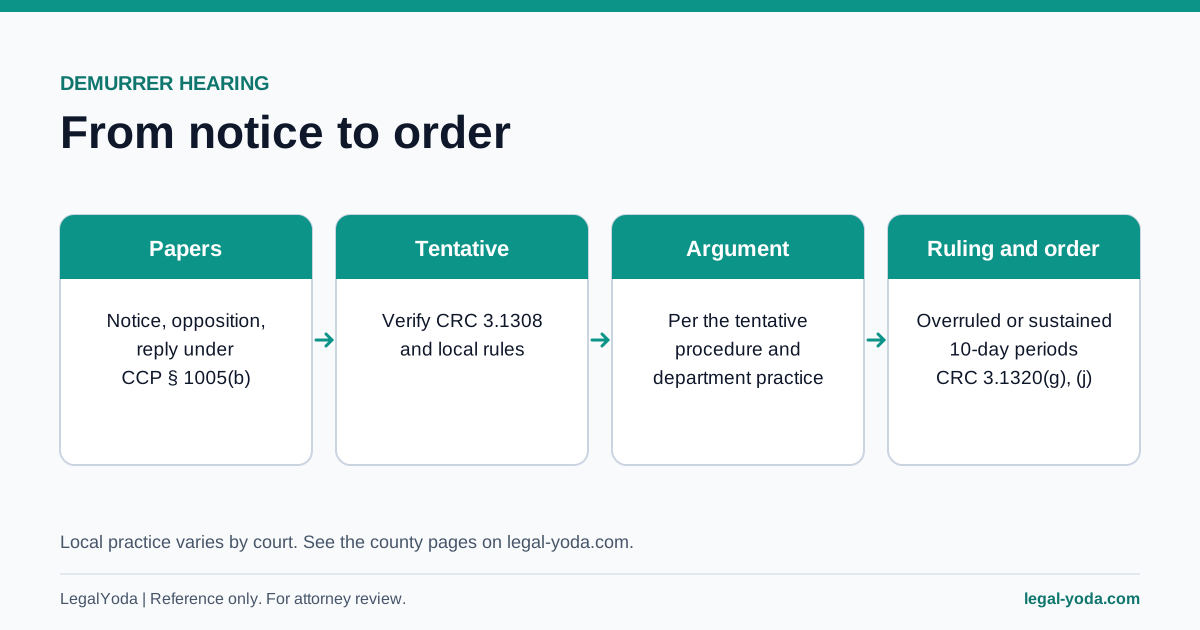
A demurrer hearing is short and mostly procedural, and what happens in the days before it often matters more than the argument. This article follows the sequence from notice to order using the cached statutes and rules, and it says plainly where the cache stops: the rule on tentative rulings, the rule on proposed orders and each court’s own practice are outside it. For local practice, use the county pages linked below and the court’s website.
What happens at a demurrer hearing in California: the setup
The hearing exists because the demurring party noticed it. CRC 3.1320(c) requires a notice of hearing filed with the demurrer that specifies a hearing date in accordance with CCP § 1005, and CRC 3.1320(d) requires demurrers to be set for hearing not more than 35 days after filing or on the first date available to the court after that. For good cause the court may order the hearing earlier or later on the notice it prescribes.
Under CCP § 1005(b), the moving papers are due at least 16 court days before the hearing, the opposition at least nine court days before, and the reply at least five court days before. By the time anyone is in the courtroom or on the video line, all three sets of papers should already be filed, and a continuance changes every date in the chain.
Tentative rulings: verify the rule and the local practice
A court may issue a tentative ruling before the hearing. The statewide rule on tentative rulings is CRC 3.1308, which is not in the cache, so what it requires, how a party contests a tentative and what happens if no one does are points to read in the current rule and in the court’s own local rule.
The county pages linked below record what the stored local rules say for each covered county, including whether the rules address tentative rulings at all. They do not substitute for the department’s published procedures. The assigned judge’s procedures or the clerk’s notice may add steps, and a courtesy copy or reservation requirement can differ from department to department.
Argument
The statutes cached for this article say nothing about how long argument runs, who argues first or whether argument is allowed after a tentative. Those are matters for the rule on tentative rulings and for local rules and department practice. Counsel generally want to know before the day whether the court will hear argument at all, and the answer comes from the court’s published procedures rather than from the Code of Civil Procedure.
What the statutes do say about the substance is narrow. CCP § 430.30(a) allows the objection to be taken by demurrer when the ground appears on the face of the pleading, or from a matter of which the court is required to or may take judicial notice. Whether a court will consider anything beyond those two sources at the hearing is a case-law question that the cache does not answer.
The ruling
The court can overrule the demurrer, sustain it with leave to amend, or sustain it without leave to amend. A ruling can differ by cause of action, because CCP § 430.50(a) allows a demurrer to be taken to the whole complaint or to any of the causes of action in it and CRC 3.1320(a) requires each ground to say which causes of action it covers.
The meet and confer record does not decide the outcome. CCP § 430.41(a)(4) says a determination that the meet and confer process was insufficient shall not be grounds to overrule or sustain a demurrer. Failure to file a supporting memorandum is different: CRC 3.1113(a) lets the court treat a missing memorandum as a waiver of all grounds not supported.
The order and the clocks that start
Unless otherwise ordered, CRC 3.1320(g) deems leave to answer or amend within 10 days granted following a ruling on a demurrer, and CRC 3.1320(j) gives 10 days to answer or otherwise plead after an overruling, after the time to amend expires, or after a sustaining without leave to amend. Which document starts the clock, the minute order, a signed order or a notice of ruling, is not in the cache, so confirm it from the order and the rule on proposed orders, CRC 3.1312, which is not cached.
CCP § 430.41(c) lets the court order a conference of the parties after sustaining a demurrer with leave to amend. Where it does, the time to file a demurrer to an amended pleading does not begin until the conference has concluded. CCP § 430.41(e)(1) limits the number of amendments in response to a demurrer before the case is at issue.
What to have in hand on the day
None of these are rules; they are the items that tend to be asked for, collected from the cached provisions:
- The notice of hearing and the filed papers from all sides, with the dates they were filed and served.
- The tentative ruling, if the court issued one, and the department’s procedure for contesting it, checked against CRC 3.1308 and the local rule.
- The meet and confer declaration filed under CCP § 430.41(a)(3).
- If leave to amend is likely at issue, the additional facts that could be pleaded, since CCP § 430.41(e)(1) refers to an offer of such facts.
- A way to calendar the 10-day periods in CRC 3.1320(g) and (j) as soon as the ruling is made.
Related articles
Reference only. Not legal advice. LegalYoda is a document preparation service, not a law firm.