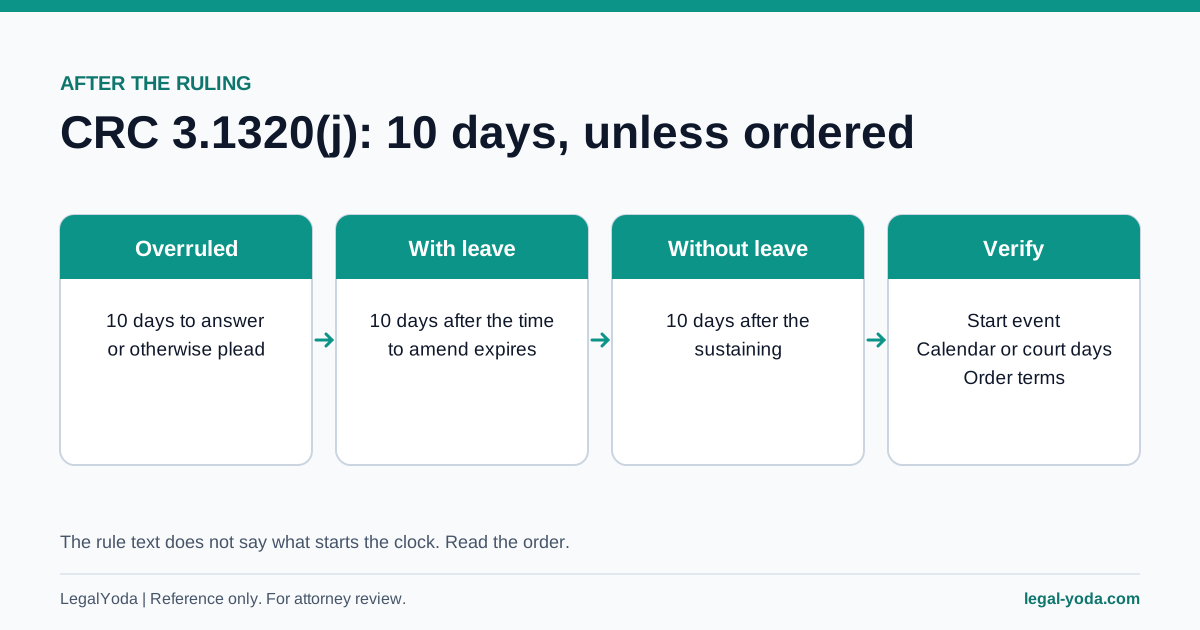
When a demurrer is overruled, the defendant still has to respond to the complaint. The cached rule that sets the time is CRC 3.1320(j), and it is short. This article reads the rule as written, notes what it does not say, covers the partial-ruling and cross-complaint wrinkles, and lists the points to confirm against the order and the current code. It is reference material and does not predict how any department will apply the rule.
Time to answer after a demurrer is overruled in California: 10 days
CRC 3.1320(j) provides that, unless otherwise ordered, the defendant has 10 days to answer or otherwise plead to the complaint or the remaining causes of action following three events: the overruling of the demurrer; the expiration of the time to amend if the demurrer was sustained with leave to amend; or the sustaining of the demurrer if it was sustained without leave to amend.
The rule opens with the words unless otherwise ordered. The order that overrules the demurrer can set a different time, so read the written order or minute order itself and not just the tentative ruling.
What the rule text does not say
The rule runs the 10 days following the overruling. The cached text does not say whether the clock starts on the date of the ruling, the date a written order is signed or entered, or the date notice of the ruling is served. It does not say whether the 10 days are calendar days or court days. Treat each of those as open until it is checked against the current rule, the order and any local rule.
On counting, CCP § 12 excludes the first day and includes the last, and CCP § 12a(a) carries a period that ends on a holiday to the next day that is not a holiday, with Saturdays counted as holidays for that purpose. Whether those provisions apply to the 10 days follows from the answer to the calendar-or-court-day question, so do not assume it.
A ruling that overrules in part
CRC 3.1320(b) allows a demurrer to a cause of action to be filed without answering the other causes of action, and CRC 3.1320(j) speaks of the complaint or the remaining causes of action. A ruling that sustains the demurrer as to some causes of action and overrules it as to others can therefore produce two clocks: the one for the remaining causes of action, and the one for the causes of action as to which leave to amend was granted.
The order should say what happens to each. Where it does not, calendar both conservatively and confirm with the department. CCP § 430.41(g) is also relevant after an overruling: if a demurrer is overruled as to a cause of action and that cause of action is not further amended, the demurring party preserves its right to appeal after final judgment without filing a further demurrer.
Cross-complaints: read the rule text closely
CCP § 432.10 gives a party served with a cross-complaint 30 days after service to move, demur or otherwise plead to it in the same manner as to an original complaint. CRC 3.1320(j), as cached, refers to answering or pleading to the complaint. It does not mention the cross-complaint by name, although CRC 3.1320(a) does. Whether (j) applies to a cross-complaint in the same way is a point to verify in the current rule before the date is set.
Why the date matters: default
The summons directs the defendant to file a written pleading in response within 30 days after service and warns that, unless the defendant responds, default will be entered on the plaintiff’s application (CCP § 412.20(a)(3) and (4)). The cache does not hold the sections on entering a default, including CCP § 585, so the steps and the time a plaintiff must wait are not stated here. The safe working assumption is that a missed response date after a demurrer ruling exposes the defendant to a default request, and the sections should be read before any date is relied on.
Stipulations and other motions
CRC 3.110(d), as cached, allows one 15-day extension by stipulation beyond the 30-day period for the response after service of the initial complaint. It does not address the period after a ruling on a demurrer. An extension after the ruling should be in the order or in a stipulation that the court approves, and the form it takes is a point to confirm with the department.
A motion to strike filed without demurring extends the time to answer under CCP § 435(c), with exceptions that refer to sections not in the cache. It does not extend the time to demur (CCP § 435(d)). If a motion to strike was filed alongside the demurrer, its ruling and the demurrer ruling may each affect the answer date, so read both orders.
The order and any court-ordered conference
Who prepares the order after a ruling is governed by a rule on proposed orders, CRC 3.1312, which is not in the cache. Verify it, because the date of the signed order may be what the department treats as the trigger. If the court ordered a conference under CCP § 430.41(c) after sustaining a demurrer with leave to amend, the time to file a demurrer to an amended pleading does not begin until the conference has concluded.
Checklist
Confirm each item against the order and the current rule:
- The ruling on each cause of action and what the order says about time to respond.
- The event that starts the 10 days, and whether they are calendar or court days.
- Whether the pleading challenged was a complaint or a cross-complaint.
- Any stipulation or order extending the date.
- Whether a motion to strike or a conference order also affects the date.
Related articles
Reference only. Not legal advice. LegalYoda is a document preparation service, not a law firm.