Attorneys evaluating AI demurrer drafting software for California usually want to know the same few things: what it produces, what it checks, what it leaves to the lawyer, and what it will not do. This article describes LegalYoda's demurrer drafting in plain terms, as it works today. It makes no claims about customers, ratings, or accuracy rates. LegalYoda is a document preparation service, not a law firm, and every draft is for attorney review.
AI demurrer drafting software for California attorneys: what it is
LegalYoda drafts California demurrers for pilot users. Other motion types are in development and are not offered for drafting today. The service is aimed at licensed attorneys who already know what they want to demur to and want a first draft on California pleading paper.
The software does not select a motion for the attorney, does not advise on strategy, and does not decide which grounds to raise. The attorney supplies the complaint and the facts and chooses what the document should do. That boundary is deliberate: choosing a legal strategy is the attorney's work, not the software's.
What a demurrer draft package contains
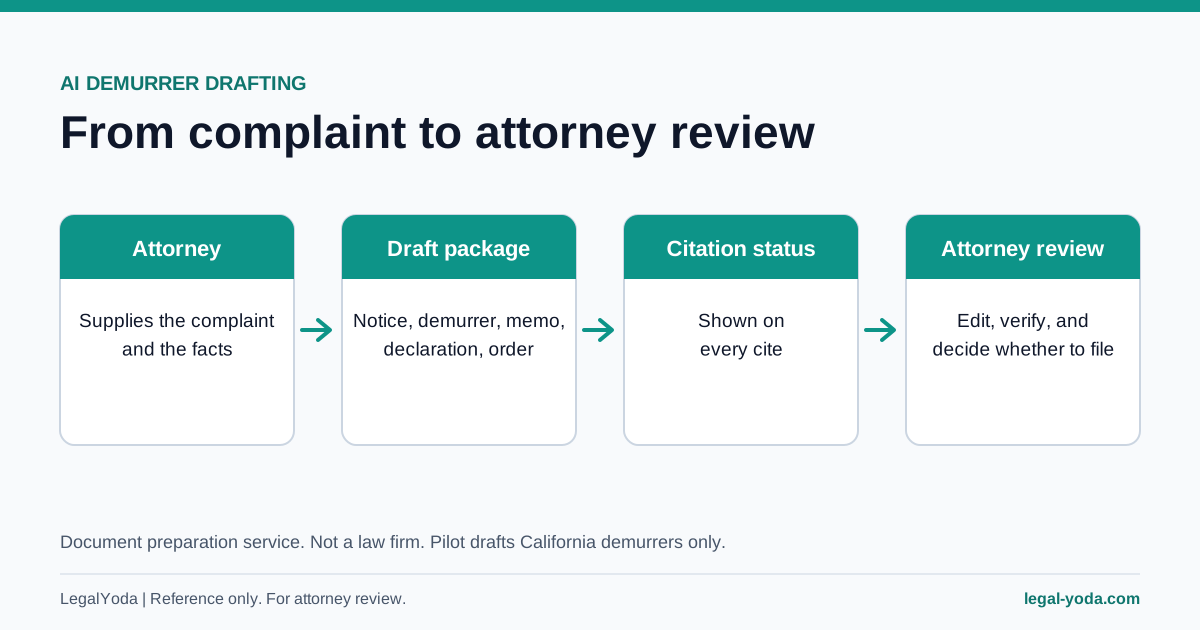
A pilot draft package contains the papers that a California demurrer requires, drawn from the same rules discussed in the other articles in this section: CRC 3.1112 (notice of hearing, motion, and memorandum), CRC 3.1320 (grounds in separate paragraphs, caption, and hearing notice), and CCP § 430.41 (the meet and confer declaration).
- Notice of hearing.
- The demurrer itself.
- Memorandum of points and authorities.
- The CCP § 430.41 declaration.
- A proposed order.
- All formatted on California pleading paper.
Citation status on every cite
Each citation in a draft carries a visible status, so the attorney can see which authorities have been checked and which still need attention. This is a check, not a certification. A status is a prompt for the attorney to verify the authority against the current code, rule or reporter before relying on it.
The cached statutory and rule text used on these article pages shows the same approach. Where a rule is in the cache, the article states what the cached text says. Where it is not, the article says to verify it and does not describe it. Quotations from cases are taken only from existing LegalYoda guides and are flagged for checking against the reporter.
The deadline calculator
LegalYoda also provides a public deadline calculator. For a demurrer it starts from the date service of the summons was complete, applies the 30-day period in CCP § 430.40(a), and counts using a California court-holiday calendar. Its notes cover the completion rules for the common service methods and the § 430.41(a)(2) declaration that provides the automatic 30-day extension.
A calculator is an aid to docketing, not an authority. The attorney remains responsible for confirming service dates, stipulated extensions, and local practice.
Where drafting software fits in a demurrer workflow
A demurrer workflow has several stages, and software can assist with some of them while others stay with the attorney. Reading the complaint, deciding whether the pleading has a ground under CCP § 430.10, and conducting the meet and confer under CCP § 430.41 are the attorney's tasks. Assembling the papers in the format the rules require, keeping the grounds in separate paragraphs as CRC 3.1320(a) provides, and tracking the dates are tasks where a tool can save time.
For that reason the useful comparison is not between software and a lawyer. It is between a blank page and a structured first draft that the lawyer then corrects. A draft that is easy to review, with clear citation statuses and visible assumptions, is more useful to a busy litigator than one that reads smoothly but hides what it relied on.
Attorney review is part of the process
Every document is prepared for attorney review. The attorney reads the draft, edits the grounds and arguments, checks the facts and the authorities, and decides whether to sign and file. A download requires an attorney acknowledgment, which is logged.
The documents carry a preparation disclaimer. LegalYoda is not a substitute for the attorney's professional judgment, and nothing in a draft is a statement that a demurrer is warranted or will succeed.
What the software does not do
A fair evaluation includes the limits.
- It does not file anything with a court, serve any party, or sign any document.
- It does not apply county local rules or department procedures, such as hearing reservations. Attorneys must check those separately.
- It does not tell the attorney whether to demur or advise on strategy.
- It does not draft other motion types today.
- It cannot replace reading the current statutes, rules and cases.
Questions to ask about any demurrer drafting software
Whatever tool is under review, these questions help separate what a product actually does from what it says it does.
- What exactly is in the output, and in what format?
- How are citations checked, and how is the result shown to the user?
- Who decides which grounds to raise: the software or the attorney?
- How are meet and confer, timing and the declaration handled?
- What happens to the facts and documents the attorney uploads?
- What does the vendor say it does not do?
The pilot
The pilot offer is simple: send a filed complaint you are about to demur to, and receive a California-formatted first draft demurrer with the CCP § 430.41 declaration for your review. Requests go through the pilot page. The draft is a starting point for the attorney's own work, not a finished filing.
Related articles
Reference only. Not legal advice. LegalYoda is a document preparation service, not a law firm.