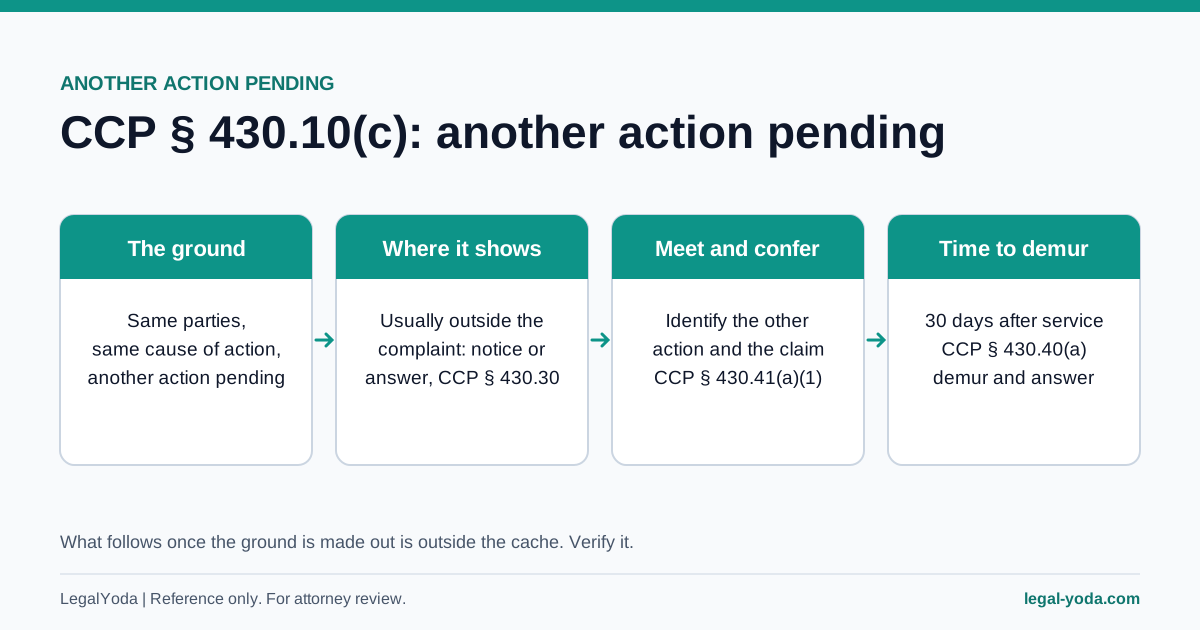
Subdivision (c) of CCP § 430.10 is the other-action-pending ground. It differs from the grounds around it because the defect is rarely in the complaint itself; it is in another case. This article sets out the cached text, how CCP § 430.30 decides between demurrer and answer, and the CCP § 430.41 and CCP § 430.40 steps. It does not state what the court does when the ground is established or how courts compare the two actions. Those points are outside the cache and have to be verified.
CCP § 430.10(c): what the subdivision says
CCP § 430.10 allows the party against whom a complaint or cross-complaint has been filed to object, by demurrer or answer as provided in CCP § 430.30, to the pleading on any one or more of the listed grounds. Subdivision (c) reads: there is another action pending between the same parties on the same cause of action.
The sentence has three parts that a paragraph in a demurrer has to be able to support: another action is pending, it is between the same parties, and it is on the same cause of action. The statute adds nothing about which court the other action is in, how far along it is, or how closely the two pleadings must match.
What the text leaves to other authority
The cache does not contain any provision or decision that explains how the three parts are measured, where the other action may be pending, or what follows once the ground is made out. This article does not fill that gap. A drafter needs the current authority for each part, and the meet and confer under CCP § 430.41(a)(1) requires that authority to be identified with the cause of action it applies to.
The ground is stated in terms of the cause of action, so the paragraph is built cause of action by cause of action. CCP § 430.50(a) allows a demurrer to the whole complaint or to any of its causes of action, and CRC 3.1320(a) requires the paragraph to say which. A complaint that overlaps another case on one claim and not on another calls for a paragraph aimed at the one.
CCP § 430.30: the other case is usually outside the complaint
CCP § 430.30(a) allows a demurrer when the ground appears on the face of the pleading or from any matter of which the court is required to or may take judicial notice. CCP § 430.30(b) provides that when the ground does not appear on the face of a complaint or cross-complaint, the objection may be taken by answer. CCP § 430.30(c) allows a demurrer and an answer at the same time.
A complaint seldom pleads that the plaintiff has sued on the same claim elsewhere, so this ground tends to depend on matter outside the pleading. Two routes follow from the text. If the other action can be shown through a matter the court may judicially notice, the objection may be taken by demurrer under CCP § 430.30(a); the article on requests for judicial notice covers the papers. If it cannot, the objection may be taken by answer under CCP § 430.30(b). Whether the court will notice a particular record, and for what purpose, is for the evidence provisions and case law, not the cache.
The existing LegalYoda demurrer guide quotes Blank v. Kirwan (1985) 39 Cal.3d 311, 318, quoting Serrano v. Priest (1971) 5 Cal.3d 584, 591: “We treat the demurrer as admitting all material facts properly pleaded, but not contentions, deductions or conclusions of fact or law. [Citation.] We also consider matters which may be judicially noticed.” That quotation is reproduced from the guide and should be checked against the reporter before it is used in a filing (verify).
General or special: a practice label to verify
Practitioners commonly sort subdivision (c) among the special demurrer grounds. That comes from practice and case law, not from the cached text of CCP § 430.10, and it should be verified. In the cache, CRC 3.1113(a) is the rule that mentions a special demurrer, treating a missing memorandum as an admission that the motion or special demurrer is not meritorious and, for a demurrer, as a waiver of all grounds not supported. CCP § 92(c) states that special demurrers are not allowed; confirm in the current code which cases it governs.
Meet and confer under CCP § 430.41
CCP § 430.41(a) requires a meet and confer in person, by telephone or by video conference before the demurrer is filed. Under CCP § 430.41(a)(1) the demurring party identifies the specific causes of action it believes are subject to demurrer and the legal support for the deficiency. For this ground, the conference letter is the natural place to identify the other action: its court, its caption and its case number, and which cause of action in the new complaint it overlaps.
The party who filed the pleading must provide legal support for its position that the pleading is sufficient or explain how it could be amended. What an amendment could do about a pending action in another case is not addressed in the text. If no agreement is reached, CCP § 430.41(a)(3) requires a declaration filed and served with the demurrer stating how the parties met and conferred and that no agreement was reached, or that the other side failed to respond or to meet and confer in good faith.
Timing under CCP § 430.40
CCP § 430.40(a) allows a person against whom a complaint or cross-complaint has been filed to demur within 30 days after service. Under CCP § 430.41(a)(2) the meet and confer takes place at least 5 days before the responsive pleading is due, and an automatic 30-day extension is available by a declaration under penalty of perjury filed and served on or before the date a demurrer would be due. The cached sections give this ground no separate period.
Because CCP § 430.30(c) allows a demurrer and an answer at the same time, a party who is not sure the other action can be shown from noticeable matter can plead the ground in both places. CCP § 430.41(f) refers to CCP § 430.80, which is not cached; read it in the current code to see what an objection not raised by demurrer or answer costs.
Checklist
Items to confirm in the current code before a subdivision (c) paragraph is filed:
- The caption, court and case number of the other action, and its current status.
- Authority, outside the cache, for the same-parties and same-cause-of-action comparison and for what follows if the ground is made out.
- Whether the other action can be shown by judicially noticeable matter (CCP § 430.30(a)) or must be raised by answer (CCP § 430.30(b)).
- Which causes of action overlap, stated in the meet and confer and in the paragraph (CCP § 430.41(a)(1), CRC 3.1320(a)).
- The demurrer date, the declaration under CCP § 430.41(a)(3) and any extension (CCP § 430.40(a), CCP § 430.41(a)(2)).
- What CCP § 430.80 provides for objections not raised by demurrer or answer.
Related articles
- Request for Judicial Notice on a DemurrerRead article
- CCP 430.10(b): Legal Capacity to SueRead article
- CCP 430.10(d): Defect or Misjoinder of PartiesRead article
- Grounds for Demurrer in CaliforniaRead article
- Demurrer Meet and Confer Letter and DeclarationRead article
- General vs Special Demurrer in CaliforniaRead article
Reference only. Not legal advice. LegalYoda is a document preparation service, not a law firm.