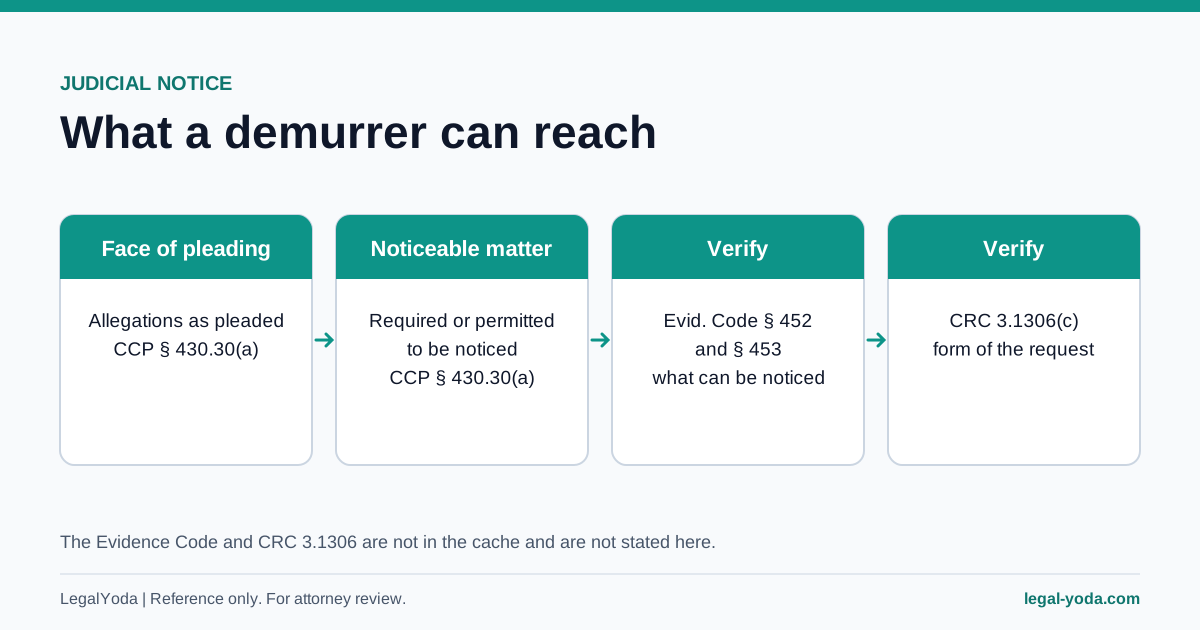
A demurrer is decided on the pleading. A request for judicial notice is how a party asks the court to look at something else without converting the motion into a different one. This article sticks to what the repository’s cache supports: the statutory hook in CCP § 430.30(a), the surrounding rules on memoranda and timing, and one case passage already used in the other articles on this site. The Evidence Code sections and the Rule of Court that decide what can actually be noticed are not in the cache, and they are marked verify throughout.
The statutory hook: CCP § 430.30(a)
CCP § 430.30(a) provides that when any ground for objection to a complaint, cross-complaint, or answer appears on the face of the pleading, or from any matter of which the court is required to or may take judicial notice, the objection on that ground may be taken by a demurrer. Those are the two sources the statute names. A request for judicial notice is the vehicle for the second one.
Subdivision (b) is the other side of the same coin. When the ground for objection to a complaint or cross-complaint does not appear on the face of the pleading, the objection may be taken by answer. A demurrer that depends on a fact found only outside the complaint, and not in a noticeable source, is therefore a candidate for an answer instead. Subdivision (c) lets a party demur and answer at the same time.
The demurrer reads noticeable matter too
The existing LegalYoda demurrer guide quotes Blank v. Kirwan (1985) 39 Cal.3d 311, 318, quoting Serrano v. Priest (1971) 5 Cal.3d 584, 591: “We treat the demurrer as admitting all material facts properly pleaded, but not contentions, deductions or conclusions of fact or law. [Citation.] We also consider matters which may be judicially noticed.” That quotation is reproduced from the guide and should be checked against the reporter before it is used in a filing (verify).
The passage matches the structure of the statute: pleaded facts on one side, noticeable matter on the other. It does not say which matters qualify. That question is outside what this article can answer from the cache.
What can be noticed: verify Evidence Code §§ 452 and 453
The rules that decide what a court may or must notice, and what a party has to provide with a request, are in the Evidence Code. Evidence Code §§ 452 and 453 are the sections usually named on this topic, and neither is in the cache. This article does not state what they say. Read the current text of both before drafting a request, and check the case law on the difference between noticing that a document exists, noticing what it says, and noticing that what it says is true. Those can be different questions with different answers (verify).
The same applies to the usual candidates people bring: court filings in the same or another action, official records, and documents attached to the complaint. Whether each one qualifies, and for what purpose, has to come from the sections and cases rather than from a list here.
Form of the request: verify CRC 3.1306
CRC 3.1306, in its subdivision on judicial notice, is the Rule of Court usually named for requests for judicial notice. It is not in the cache, so what it requires about form, whether the request is a separate document, and what must accompany it are points to confirm in the current rule. The existing article on what a demurrer package contains likewise treats a request for judicial notice as a separate paper whose requirements are outside the cache.
Many departments have their own expectations on top of the statewide rule. The county pages linked below describe two stored examples. The Los Angeles page describes a local rule on requests for a court file in the same district, made to the clerk before the hearing. The San Mateo page describes a rule requiring bookmarks on exhibits to e-filed papers, with rejection or a continuance as consequences. Neither substitutes for reading the rule itself.
Memorandum, timing and page limits
A request does not replace the memorandum. CRC 3.1113(a) requires a supporting memorandum for a demurrer, and the court may treat its absence as a waiver of all grounds not supported. If a ground depends on a noticed document, the memorandum is where the connection between the document and the ground is explained, not the request alone.
Timing follows the motion. Under CCP § 1005(b), moving and supporting papers are due at least 16 court days before the hearing, opposing papers at least nine court days before, and reply papers at least five court days before. A request offered in support of the demurrer reads, on its face, as a supporting paper on the 16-court-day schedule. A request offered with an opposition or a reply raises the question of which schedule it falls under and whether the department accepts it, which is a point to verify.
Page limits matter for how the material is packaged. CRC 3.1113(d) excludes exhibits, declarations and attachments from the page count of a memorandum. The cached rule does not say how a court treats argument placed in a request or an attachment, so keep the argument in the memorandum and limit the request to identifying the item and the basis for noticing it (verify).
Responding to a request
The statute’s own limit is useful for opposing counsel. If the demurring party’s ground is not on the face of the complaint and does not come from a noticeable matter, CCP § 430.30(b) points the objection to an answer, and a response can say so. A response can also ask for the specific item and the purpose for which it is offered to be identified. What the court does with an item that is noticeable for one purpose but offered for another is case-law territory (verify).
The article on what happens at a demurrer hearing covers the sequence of the hearing, and the one on the briefing schedule covers the dates.
Checklist before filing a request
Items to confirm, in order:
- The ground in the demurrer, and why it does not appear on the face of the complaint.
- The exact item to be noticed, as a complete and legible copy with the source identified.
- The current text of Evidence Code §§ 452 and 453 and CRC 3.1306, and the purpose for which each item is offered.
- That the memorandum, not the request, makes the argument, and stays within the page limit in CRC 3.1113(d).
- The service and filing date under CCP § 1005(b) for the paper the request travels with.
- Any local rule or department procedure on judicial notice or exhibits.
Related articles
- Demurrer on Statute of Limitations in CaliforniaRead article
- Demurrer for Failure to State a Cause of ActionRead article
- California Demurrer Template: What It ContainsRead article
- What Happens at a Demurrer Hearing in CaliforniaRead article
- Demurrer Briefing Schedule in CaliforniaRead article
- CCP 430.10(c): Another Action PendingRead article
Reference only. Not legal advice. LegalYoda is a document preparation service, not a law firm.