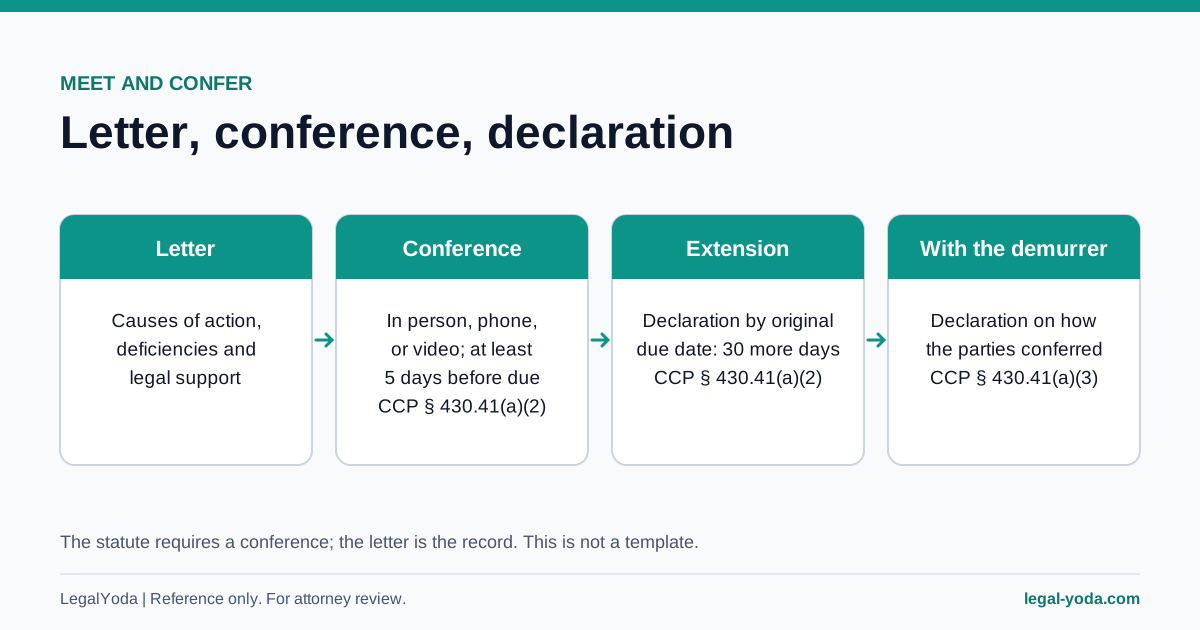
Searches for a "sample meet and confer letter" for a California demurrer are common, and this article does not supply a template. It sets out what the cached text of CCP § 430.41 requires each piece of paper to contain, and when each is due. The statute does not prescribe a letter at all. It prescribes a conference, and then a declaration. The letter is the record that makes the conference concrete and gives the declarant something to describe.
The letter is not the conference
CCP § 430.41(a) requires the demurring party to meet and confer in person, by telephone, or by video conference with the party who filed the pleading subject to demurrer. The three listed methods do not include an exchange of letters or email. Whether a written exchange alone ever satisfies the statute is not answered by the cached text, so treat that as a question to verify in case law and in the assigned department’s practice before relying on it.
A letter still has a job. Subdivision (a)(1) makes the conference substantive: the demurring party must identify all of the specific causes of action it believes are subject to demurrer and identify with legal support the basis of the deficiencies. A letter sent ahead of the call puts that content in writing, fixes the date, and lets the other side prepare its response to the same list.
What the letter needs to contain to track the statute
The statute does not list letter contents. Reading subdivision (a)(1) and (a)(2) together, a letter that tracks the statute would cover the following. This is drafting practice drawn from the statutory language, not a rule that a court has to accept.
- A request to meet and confer by one of the three listed methods, with proposed dates and times.
- A date for the conference that falls at least 5 days before the responsive pleading is due (subdivision (a)(2)), with the due date stated.
- Each cause of action the demurring party believes is subject to demurrer, listed one by one.
- For each, the deficiency and the legal support for it, and the CCP § 430.10 ground it falls under.
- A request that the other side provide its legal support for sufficiency or say how the pleading could be amended to cure the defect, which is what the statute asks of the pleading party.
- A statement of whether the demurring party intends to file the extension declaration if no conference can be held in time.
Timing, and the extension declaration
Under subdivision (a)(2), the parties are to meet and confer at least 5 days before the date the responsive pleading is due. For an original complaint or cross-complaint, CCP § 430.40(a) allows 30 days after service to demur. The letter therefore has to go out early enough to leave room for the other side to respond and for a call to be set before the 5-day mark.
If no conference can happen by then, the demurring party is granted an automatic 30-day extension by filing and serving, on or before the date on which a demurrer would be due, a declaration stating under penalty of perjury that a good faith attempt to meet and confer was made and explaining the reasons why the parties could not meet and confer. The extension runs from the date the responsive pleading was previously due, and the demurring party is not subject to default during it. Any further extension is by court order on a showing of good cause.
The letters sent in the attempt are the factual basis for that declaration. A dated letter, a reply or the absence of one, and a record of calls or video invitations let the declarant state what was attempted and why it did not result in a conference.
The declaration filed with the demurrer under § 430.41(a)(3)
Subdivision (a)(3) requires the demurring party to file and serve with the demurrer a declaration that states one of two things. The text of each option is short, and the declaration should match the facts of the case rather than a form.
- Option (A): the means by which the demurring party met and conferred with the party who filed the pleading subject to demurrer, and that the parties did not reach an agreement resolving the objections raised in the demurrer.
- Option (B): that the party who filed the pleading subject to demurrer failed to respond to the meet and confer request of the demurring party or otherwise failed to meet and confer in good faith.
Building the declaration from the record
For option (A), the statutory words are "the means by which." That points to the method (in person, telephone or video), the date, who took part, and the outcome. The letter attached or described gives the date of the request and the list of causes of action that was sent. A declaration that stays on those facts leaves less to argue about than one that characterizes the other side’s positions.
For option (B), the declaration is making an assertion about the other party’s conduct: no response, or a failure to meet and confer in good faith. Those are different statements. A failure to respond is shown by the dated requests and the silence. A failure to confer in good faith is a characterization, and the declaration should give the facts that support it rather than the conclusion alone. Each fact should be confirmed by the declarant before signing. The cached text of subdivision (a)(3) does not itself say “under penalty of perjury,” unlike the extension declaration in subdivision (a)(2), so check the current rules on declarations for the form of the signature (verify).
What the statute leaves out, and what stays open
Subdivision (a)(4) says a determination by the court that the meet and confer process was insufficient shall not be grounds to overrule or sustain a demurrer. The statute therefore limits one consequence of a thin conference. It does not say what a court may do about a missing or defective declaration. Courts may have their own practices, and the San Bernardino and Sonoma county pages linked below describe stored local rules that touch the declaration and a facilitator program. Read those pages and the court’s current rules for the assigned department.
The requirement renews after an amended pleading (subdivision (a)), does not apply in the actions listed in subdivision (d) such as unlawful detainer, and works alongside the court-ordered post-ruling conference in subdivision (c). The article on the meet and confer requirement covers those provisions in order.
Checklist before filing
Items to confirm for the letter and declaration on each demurrer:
- The responsive pleading due date and the date 5 days before it.
- A written request sent early enough, naming causes of action, deficiencies and legal support.
- The method used and the date of the conference, or the record of attempts that did not produce one.
- Whether the extension declaration was filed and served on or before the original due date.
- Which subdivision (a)(3) option matches the facts, and whether each statement in it can be supported.
- Any local rule or department practice on the declaration for the court where the demurrer is set.
Related articles
Reference only. Not legal advice. LegalYoda is a document preparation service, not a law firm.