California practitioners often talk about general and special demurrers, but those labels do not appear in the text of CCP § 430.10. The statute lists grounds by subdivision and leaves the vocabulary to practice and case law. This article explains what the cached statutes and rules say, which of them refer to a special demurrer, and where counsel should verify the terminology against current authority before using it in a filing.
General vs special demurrer in California: where the terms come from
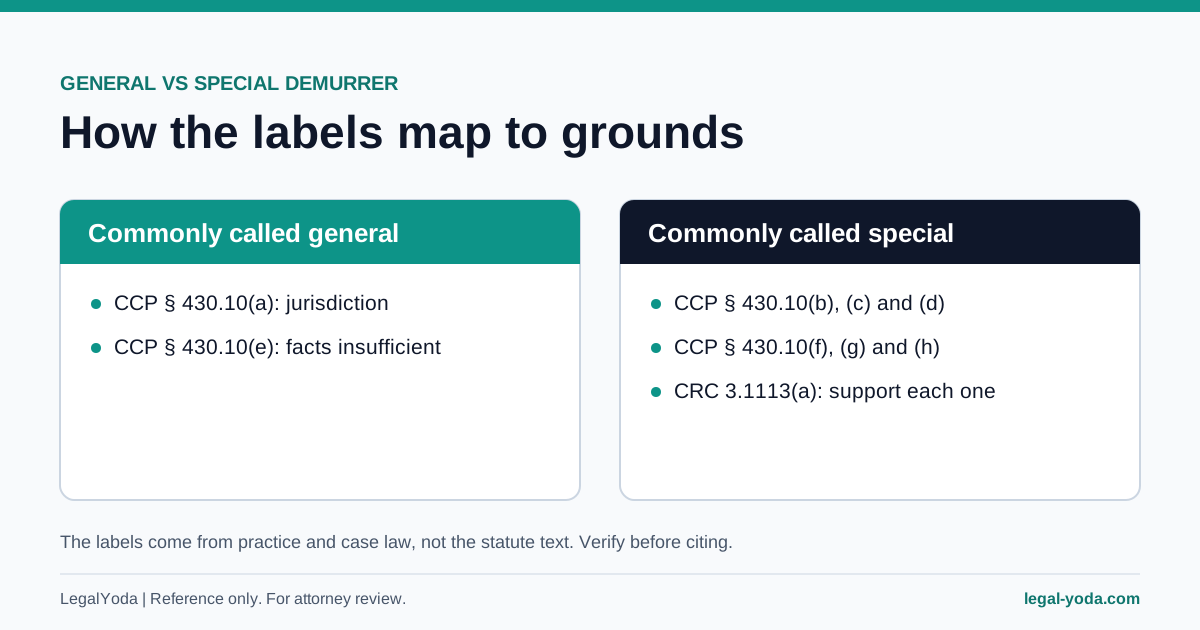
CCP § 430.10 lists eight grounds for demurrer in subdivisions (a) through (h). It does not use the words general or special. Practitioners commonly use general demurrer to describe an objection that the court lacks subject matter jurisdiction or that the pleading fails to state facts sufficient to constitute a cause of action, which are subdivisions (a) and (e), and special demurrer for the other grounds. That usage comes from practice and case law rather than from the cached statutory text, so it should be verified against current authority before it is repeated in a brief.
The distinction matters mainly because some rules treat the two kinds of objection differently. The rest of this article sticks to what the cached text of the statutes and rules actually provides.
For drafting purposes the label is less important than the subdivision. A demurrer paragraph should always name the CCP § 430.10 subdivision it relies on, so the court and opposing counsel can see the ground without depending on a shorthand term that the statute itself never uses.
How the grounds line up
Using the common usage described above, the grounds sort as follows. This is a map for orientation and not a statement of law.
- Commonly called general: CCP § 430.10(a), no jurisdiction of the subject of the cause of action; and § 430.10(e), failure to state facts sufficient to constitute a cause of action.
- Commonly called special: § 430.10(b) capacity, (c) another action pending, (d) defect or misjoinder of parties, (f) uncertainty, (g) contract written, oral, or implied, and (h) the missing certificate.
- Grounds for demurring to an answer are listed separately in CCP § 430.20 and should be checked there.
What CRC 3.1113 says about a special demurrer
The one place in the cached rules where the term appears is CRC 3.1113(a). It states that a party filing a motion, except for a motion listed in rule 3.1114, must serve and file a supporting memorandum, and that the court may construe the absence of a memorandum as an admission that the motion or special demurrer is not meritorious and cause for its denial and, in the case of a demurrer, as a waiver of all grounds not supported.
The rule is drafted in terms of a missing memorandum. The cautious reading for a drafter is that every ground raised in the demurrer should be supported by argument in the memorandum. Whether a memorandum that addresses some grounds and skips others triggers waiver of the skipped ones is a question for the current rule and case law.
Separate paragraphs and scope under CRC 3.1320
CRC 3.1320(a) applies to every ground regardless of label. Each ground of demurrer must be in a separate paragraph and must state whether it applies to the entire complaint, cross-complaint, or answer, or to specified causes of action or defenses. That makes the practical drafting structure simple: one paragraph per ground, each identifying its target.
CRC 3.1320(b) allows a demurrer to a cause of action to be filed without answering other causes of action, and CCP § 430.50(a) allows a demurrer to the whole complaint or to any of its causes of action. Each paragraph should therefore name the causes of action to which its ground applies, rather than sweeping in every cause of action.
The same face-of-the-pleading limit applies to both
CCP § 430.30(a) lets a party demur when a ground appears on the face of the pleading or from a matter of which the court is required to or may take judicial notice. That rule does not distinguish between the two categories. A special-demurrer ground such as uncertainty, a defect of parties, or the unascertainable-contract ground must also be visible in the pleading or in noticeable matter.
If a ground is not visible, the statute says the objection to a complaint or cross-complaint may be taken by answer (CCP § 430.30(b)). A party may also demur and answer at the same time (CCP § 430.30(c)).
Uncertainty as the example of a special demurrer
The existing LegalYoda demurrer guide cites Khoury v. Maly's of California, Inc. (1993) 14 Cal.App.4th 612, 616, for the point that a demurrer for uncertainty is strictly construed. That caution is useful when deciding how much of a brief to devote to a ground under subdivision (f). The meet and confer under CCP § 430.41(a)(1) also requires the demurring party to identify the specific causes of action and the legal support for each claimed deficiency, which applies to every ground.
Practical checklist
When using the general and special labels in a draft, confirm the following.
- The label matches current case law. Verify before citing it, since the cached statutes do not define it.
- Each ground is in its own paragraph with its target stated (CRC 3.1320(a)).
- Each ground has argument in the memorandum (CRC 3.1113(a)).
- Each ground appears on the face of the pleading or in judicially noticeable matter (CCP § 430.30(a)).
- The grounds were raised during the meet and confer (CCP § 430.41(a)(1)).
Related articles
- Grounds for Demurrer in CaliforniaRead article
- How to Write a Demurrer in CaliforniaRead article
- Demurrer for Failure to State a Cause of ActionRead article
- Special Demurrer in CaliforniaRead article
- CCP 430.10(a): No Jurisdiction of the SubjectRead article
- CCP 430.10(e): Facts Not SufficientRead article
Reference only. Not legal advice. LegalYoda is a document preparation service, not a law firm.