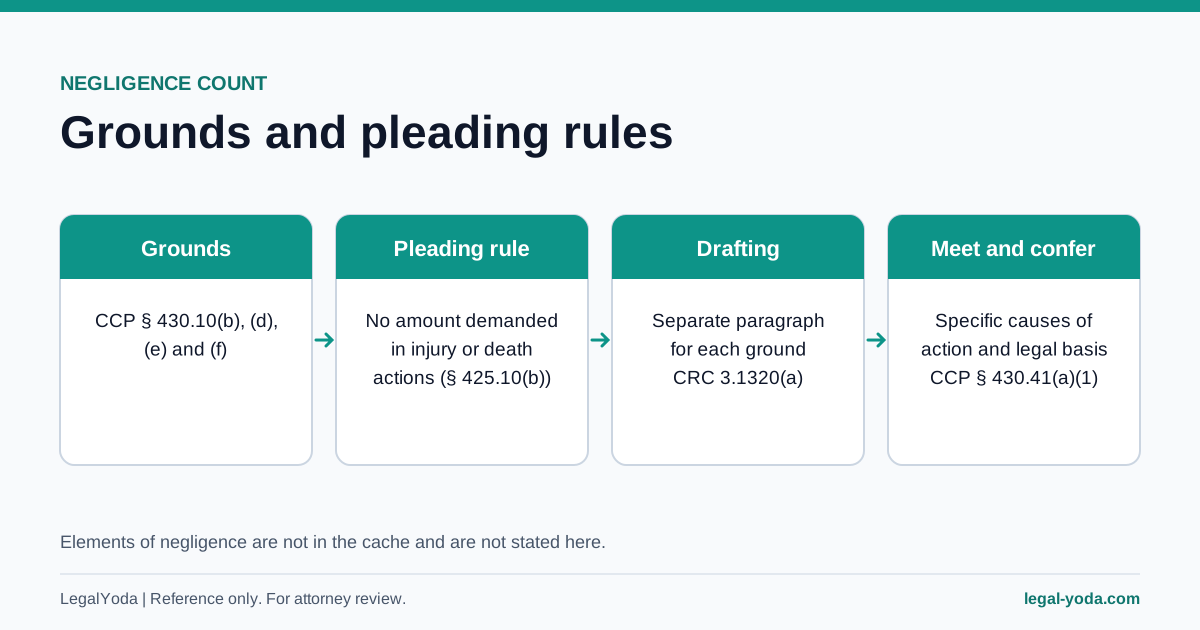
A negligence cause of action is usually challenged under the same grounds as any other count, and the procedure is the same as for any demurrer. This article sets out the cached provisions that frame a demurrer to a negligence claim, including the special pleading rule for personal injury and wrongful death in CCP § 425.10(b), and the drafting and meet and confer steps. It does not state the elements of negligence or how courts apply them. Those come from case law, which the repo does not cache, and have to be verified.
Demurrer to a negligence claim in California: the grounds
The grounds are the ones in CCP § 430.10. For a negligence count, two grounds that go to the content of the pleading are subdivision (e), that the pleading does not state facts sufficient to constitute a cause of action, and subdivision (f), that it is uncertain. Subdivision (d), defect or misjoinder of parties, and subdivision (b), lack of legal capacity to sue, address who is suing and who is sued.
The cached statutes do not say what facts a negligence cause of action requires. A subdivision (e) argument depends on that law, and the brief has to take it from a verified current source. This article does not supply it.
Pleading rules for personal injury and wrongful death
CCP § 425.10(a) requires a complaint to contain a statement of the facts constituting the cause of action, in ordinary and concise language, and a demand for judgment. Subdivision (b) adds a rule for actions to recover actual or punitive damages for personal injury or wrongful death: the amount demanded shall not be stated, but the complaint shall comply with CCP § 422.30, which sets out what a caption contains.
A complaint that states a dollar amount in such an action raises a conformity question rather than an obvious ground under CCP § 430.10, which lists no ground of that kind. CCP § 436(b) lets the court strike a pleading or part of it not drawn or filed in conformity with the laws of this state, a court rule or an order of the court, on a motion under CCP § 435. Whether that is the right vehicle is a point to verify, and the article on demurrer versus motion to strike covers how the two motions are filed together.
What the court looks at
CCP § 430.30(a) allows the objection to be taken by demurrer when it appears on the face of the pleading or from a matter of which the court is required to or may take judicial notice. For negligence, that means a demurrer works from what the complaint alleges. A defense that depends on facts outside the complaint is, under § 430.30(b), taken by answer, and CCP § 431.30(b)(2) provides for a statement of new matter constituting a defense. Whether anything else may be considered at the hearing is a case-law question.
If the defendant is a public entity, whether the complaint addresses any pre-suit claim requirement is governed by statutes that are not in the cache. Verify them directly; this article does not state them.
Drafting a demurrer to a negligence count
CRC 3.1320(a) requires each ground of demurrer to be in a separate paragraph and to state whether it applies to the entire complaint or to specified causes of action. A complaint with negligence and other counts needs the negligence grounds addressed to that count by name. CRC 3.1320(b) allows a demurrer to one cause of action without answering the others, and CRC 3.1320(e) puts the names of the filing party and the party whose pleading is challenged on the first page.
Under CRC 3.1112(d), a motion that challenges a pleading states the specific portion challenged. The memorandum is limited to 15 pages under CRC 3.1113(d), and a missing memorandum risks a waiver of grounds not supported (CRC 3.1113(a)).
Meet and confer on a negligence count
CCP § 430.41(a)(1) requires the demurring party to identify the specific causes of action and the legal basis for the deficiencies, and it requires the plaintiff to provide legal support that the pleading is sufficient or to say how it could be amended to cure the problem. The conference is at least 5 days before the responsive pleading is due, and a declaration under § 430.41(a)(3) is filed and served with the demurrer. A court determination that the meet and confer was insufficient is not a ground to overrule or sustain the demurrer (CCP § 430.41(a)(4)).
The amendment rules in CCP § 430.41(b) and (e) matter for a negligence count in the same way as any other. Grounds that could have been raised against the earlier version of a pleading are barred from a later demurrer, and amendments in response to demurrers before the case is at issue are limited to three absent an offer of additional facts.
After the ruling
The same post-ruling rules apply. CRC 3.1320(g) deems leave to answer or amend within 10 days granted unless otherwise ordered, and CRC 3.1320(j) gives 10 days to answer or otherwise plead after an overruling, the expiration of the time to amend, or a sustaining without leave to amend. The standard for granting leave to amend is case law and is not stated here.
Checklist
Items to confirm before a negligence demurrer is drafted:
- The elements of the claim and cases applying them, from a verified current source (not stated here).
- Which ground applies: CCP § 430.10(e), (f), (d) or (b), each in its own paragraph.
- Whether the complaint states a dollar amount in a personal injury or wrongful death action (CCP § 425.10(b)) and whether a motion under CCP § 436 is the vehicle.
- Whether the defendant is a public entity and what pre-suit requirements apply (not in the cache).
- The meet and confer record and declaration (CCP § 430.41(a)).
Related articles
Reference only. Not legal advice. LegalYoda is a document preparation service, not a law firm.