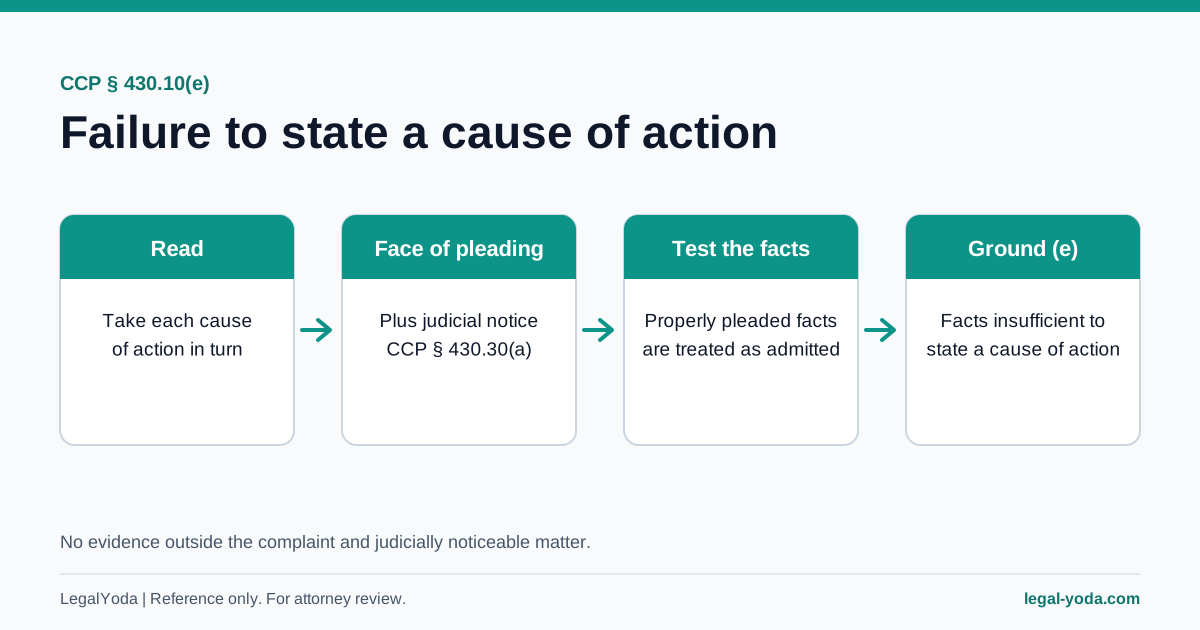
The most familiar basis for a California demurrer to a complaint is that the pleading does not state facts sufficient to constitute a cause of action. That ground is subdivision (e) of CCP § 430.10. This article describes how the statute frames it, what a court may consider in ruling, how to organize the argument cause by cause, and where the repo's existing guide quotes case law that can be reused. It does not evaluate any particular complaint.
Demurrer to a complaint for failure to state a cause of action: the statutory ground
CCP § 430.10(e) allows a demurrer where the pleading does not state facts sufficient to constitute a cause of action. The statute speaks of a complaint or cross-complaint, and CCP § 430.50(a) allows the demurrer to be taken to the whole pleading or to any of the causes of action stated in it. For this ground the second option is usually the more precise: the argument runs cause of action by cause of action, not against the complaint as a whole.
Because the ground tests the pleading, it is not a vehicle for contesting the plaintiff's evidence. The question is whether the facts alleged, if taken as true, state a claim.
What the court may look at
CCP § 430.30(a) allows the objection by demurrer when the ground appears on the face of the pleading or from any matter of which the court is required to or may take judicial notice. Evidence outside the complaint is not part of that. A demurrer that depends on a declaration or on facts the defendant would like the court to accept is outside what the statute describes.
The existing LegalYoda demurrer guide quotes Blank v. Kirwan (1985) 39 Cal.3d 311, 318, quoting Serrano v. Priest (1971) 5 Cal.3d 584, 591: “We treat the demurrer as admitting all material facts properly pleaded, but not contentions, deductions or conclusions of fact or law. [Citation.] We also consider matters which may be judicially noticed.” That quotation is reproduced from the guide and should be checked against the reporter before it is used in a filing.
The plaintiff may rely on any legal theory
The same guide cites Aubry v. Tri-City Hospital Dist. (1992) 2 Cal.4th 962, 967, for the proposition that it is error to sustain a demurrer when the plaintiff has stated a cause of action under any possible legal theory. For the demurring party, that means the memorandum should address the legal theories the complaint reasonably suggests, not only the label the plaintiff placed on each count.
No other case law is cited in this article. Standards for particular claims, such as the elements of a specific tort or contract claim, vary by cause of action and should be taken from current authority for that claim.
Organizing the argument cause by cause
CRC 3.1320(a) requires each ground to be in a separate paragraph and to state whether it applies to the entire pleading or to specified causes of action. For a failure-to-state ground, that translates into one paragraph per challenged cause of action. The memorandum then follows the same order, which keeps the argument aligned with the demurrer and reduces the chance that a ground is left unsupported (CRC 3.1113(a)).
- Identify the cause of action and the facts alleged in support of it.
- State the elements the claim requires and cite current authority for them.
- Point to the element that the pleaded facts do not support, citing paragraph numbers in the complaint.
- Address whether the plaintiff could plead the missing fact, since leave to amend will be at issue.
Combining ground (e) with other grounds
Ground (e) can appear in the same demurrer as other subdivisions of CCP § 430.10, such as uncertainty under subdivision (f), each in its own paragraph. A complaint that is both unclear and legally insufficient may support both, but each paragraph needs its own support in the memorandum. The Khoury case cited in the existing guide, Khoury v. Maly's of California, Inc. (1993) 14 Cal.App.4th 612, 616, concerns the construction of an uncertainty demurrer and should be read before a ground (f) paragraph is added.
Tie the demurrer to the meet and confer
CCP § 430.41(a)(1) requires the demurring party to identify all of the specific causes of action it believes are subject to demurrer and to identify with legal support the basis of the deficiencies. The causes of action and the deficiencies named in the conference should match the ones in the demurrer, since the declaration filed with it describes that conference. The statute also requires the other side to provide legal support for its position that the pleading is sufficient or to say how it could be amended.
What happens after a ruling
If the demurrer is sustained, CRC 3.1320(g) provides that, unless otherwise ordered, leave to answer or amend within 10 days is deemed granted, subject to the exception for forcible entry, forcible detainer and unlawful detainer actions. CCP § 430.41(e)(1) limits amendments in response to a demurrer before the case is at issue to three, absent an offer of additional facts showing a reasonable possibility of cure. The separate article on leave to amend covers both rules.
Checklist for a failure-to-state demurrer
Before filing, confirm:
- Each challenged cause of action is identified in its own paragraph under CRC 3.1320(a).
- The argument relies only on the face of the complaint and judicially noticeable matter (CCP § 430.30(a)).
- Elements and authority for each claim have been checked against current sources.
- Case citations, including any reused from LegalYoda guides, are verified before filing.
- The meet and confer covered each cause of action in the demurrer.
Related articles
- Grounds for Demurrer in CaliforniaRead article
- Demurrer Leave to Amend in CaliforniaRead article
- General vs Special Demurrer in CaliforniaRead article
- How to Respond to a Demurrer in CaliforniaRead article
- Demurrer on Statute of Limitations in CaliforniaRead article
- CCP 430.10(e): Facts Not SufficientRead article
Reference only. Not legal advice. LegalYoda is a document preparation service, not a law firm.