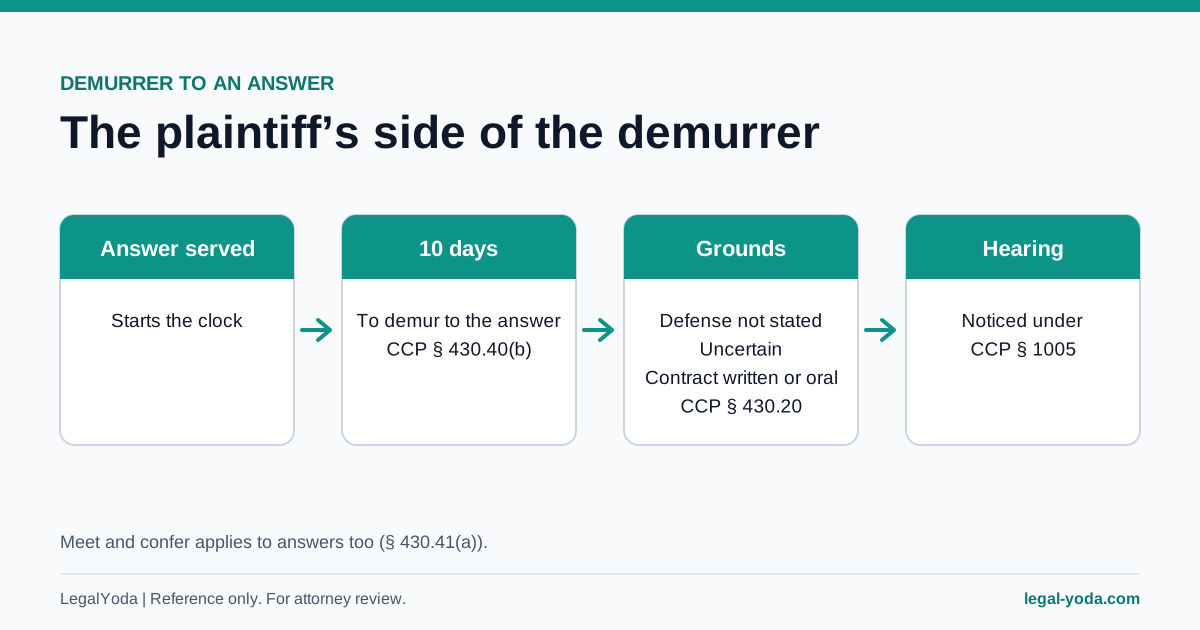
Most demurrer articles are written for the defendant who answers a complaint with a demurrer. The statute also runs the other way. A plaintiff or cross-complainant can demur to an answer, and the clock is much shorter. This article sets out what the cached text of CCP §§ 430.20, 430.30, 430.40, 430.41 and 430.50 says about that procedure, and marks the points that need the current code or case law.
Who can file a demurrer to an answer
CCP § 430.20 opens with the words a party against whom an answer has been filed. In an ordinary case that is the plaintiff, and it is also a cross-complainant when a cross-defendant files an answer. The section allows the objection by demurrer as provided in CCP § 430.30, which makes the answer the pleading under attack.
The defendant’s answer must be on file first. A demurrer to an answer is a response to an existing pleading, not a motion to test a complaint, so the parties and pleadings should be checked before the notice is drafted.
The 10-day period in CCP § 430.40(b)
CCP § 430.40(b) provides that a party who has filed a complaint or cross-complaint may, within 10 days after service of the answer to his pleading, demur to the answer. Subdivision (a) gives a defendant 30 days after service of the complaint. The period for attacking an answer is one third as long.
Count the 10 days under CCP § 12, which excludes the first day and includes the last, and CCP § 12a, which carries a last day that falls on a Saturday or holiday to the next day that is not one. The cache does not say whether service by mail or electronic means adds days to the 10. CCP § 1013 and CCP § 1010.6 address extensions after service, and the interaction should be checked in the current code before the date is relied on.
Grounds for a demurrer to an answer
CCP § 430.20 lists three grounds. The first is that the answer does not state facts sufficient to constitute a defense. The second is that the answer is uncertain, and the statute says uncertain includes ambiguous and unintelligible. The third applies where the answer pleads a contract and it cannot be ascertained from the answer whether the contract is written or oral.
These parallel subdivisions (e), (f) and (g) of CCP § 430.10, which govern demurrers to complaints. The wording differs in one way worth noting: the cached § 430.20 refers to a defense, not a cause of action, and does not include the jurisdiction, capacity, pending action or misjoinder grounds. What counts as a sufficient defense is a matter of substantive law and case law that the cache does not contain.
The objection must appear on the face of the answer
CCP § 430.30(a) provides that when a ground for objection to a complaint, cross-complaint or answer appears on its face, or from any matter of which the court is required to or may take judicial notice, the objection may be taken by demurrer. A defect that requires facts outside the answer is not a demurrer ground under that subdivision.
CCP § 430.50(b) adds that a demurrer to an answer may be taken to the whole answer or to any one or more of the defenses set up in it. Where an answer pleads several affirmative defenses, the demurrer can be directed at some and not others. CRC 3.1320(a) requires each ground to be in a separate paragraph stating whether it applies to the entire pleading or to specified defenses.
Meet and confer before demurring to an answer
The meet and confer statute is not limited to complaints. CCP § 430.41(a) requires the demurring party, before filing a demurrer under the chapter, to meet and confer in person, by telephone or by video conference with the party who filed the pleading, and it refers to amended complaints, cross-complaints and answers. A declaration describing the conference must be filed with the demurrer under subdivision (a)(3).
The five-day timing in subdivision (a)(2) is written around the date the responsive pleading is due, which fits a defendant answering a complaint. How that timing applies to a plaintiff with 10 days to demur to an answer is not spelled out in the cached text. Because the window is short, counsel should read the current statute and decide the schedule at the start of the 10 days, not near the end. Subdivision (a)(2) also provides an automatic 30-day extension in the defendant’s situation; whether it is available here is a point to verify.
Hearing and ruling
The procedural rules for demurrers apply to this one too. CRC 3.1320(c) requires a notice of hearing with a date set under CCP § 1005, and CRC 3.1320(d) says demurrers must be set for hearing not more than 35 days after filing or on the first date available to the court after that. The moving papers are due at least 16 court days before the hearing under CCP § 1005(b).
After a ruling, CRC 3.1320(g) deems leave to answer or amend granted for 10 days unless the court orders otherwise. CCP § 430.41(b) bars a party who demurs to an amended pleading from raising grounds that could have been raised against the earlier version, so the first demurrer to an answer should include every ground the party intends to press.
Checklist
Items to confirm for a demurrer to an answer:
- The date of service of the answer and the 10th day counted under CCP §§ 12 and 12a.
- Which defenses are challenged and under which subdivision of CCP § 430.20.
- Whether each ground appears on the face of the answer or a judicially noticeable matter.
- The meet and confer record and the declaration required by CCP § 430.41(a)(3).
- A hearing date that satisfies CRC 3.1320(d) and CCP § 1005(b).
Related articles
Reference only. Not legal advice. LegalYoda is a document preparation service, not a law firm.