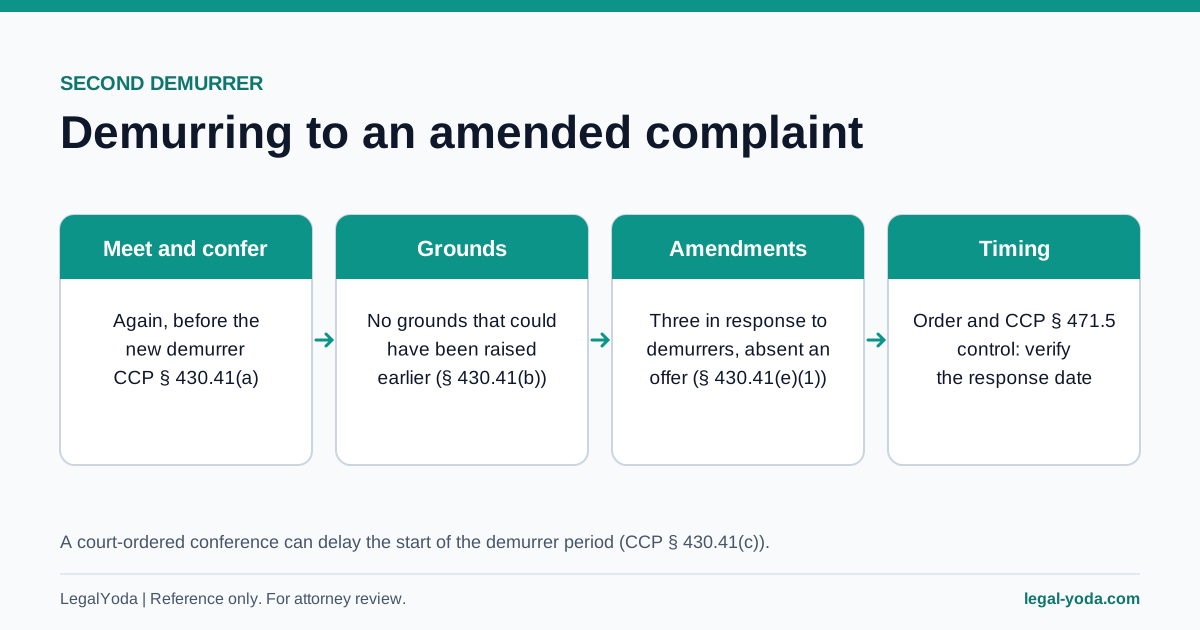
A second demurrer is not a repeat of the first. When a complaint has been amended after a demurrer was sustained, CCP § 430.41 changes what the defendant must do before filing and what it may argue. This article walks through a demurrer to a first amended complaint using the cached text of CCP § 430.41 and CRC 3.1320, and flags the points the cache does not settle: chiefly the time to respond to an amended complaint and how courts treat new allegations.
Demurrer to a first amended complaint in California: meet and confer again
CCP § 430.41(a) provides that if an amended complaint, cross-complaint or answer is filed, the responding party must meet and confer again with the party who filed the amended pleading before filing a demurrer to it. The first conference does not carry over. The timing and declaration requirements of subdivision (a) apply again, including the conference at least 5 days before the responsive pleading is due and the declaration filed and served with the demurrer.
If the parties cannot confer in time, the automatic 30-day extension in subdivision (a)(2) is available by declaration filed and served on or before the date a demurrer would be due. What that date is for an amended complaint is the next section’s question.
Time to respond to an amended complaint: verify
CCP § 430.40(a) gives 30 days after service of the complaint or cross-complaint to demur. The cached text does not say whether, or how, that period restarts for an amended complaint. CCP § 471.5 is the section that addresses responding to an amended complaint, and it is not in the cache, so read it in the current code.
The court’s order may also control. CRC 3.1320(g) deems leave to answer or amend within 10 days granted after a ruling on a demurrer unless otherwise ordered, and CRC 3.1320(j) gives 10 days to answer or otherwise plead after the time to amend expires. Those rules govern the original defendant’s time after a ruling; whether they or CCP § 471.5 fix the date for a demurrer to the amended pleading is a point to settle from the order and the current code before the date is calendared.
A court-ordered conference can move the date
CCP § 430.41(c) says that if a court sustains a demurrer to one or more causes of action and grants leave to amend, it may order a conference of the parties before an amended complaint, or a demurrer to it, may be filed. If a conference is held, the court shall not preclude a party from filing a demurrer, and the time to file a demurrer does not begin until after the conference has concluded. The subdivision also allows the court to order a conference on its own motion at any time, and a party may ask for one.
Read the minute order for any such conference. Where one was ordered, the date it concluded is the starting point for the demurrer timing, not the date the amended complaint was filed.
The bar on grounds that could have been raised earlier
Subdivision (b) of CCP § 430.41 says that a party demurring to a pleading that has been amended after a demurrer to an earlier version was sustained shall not demur to any portion of the amended pleading on grounds that could have been raised by demurrer to the earlier version. The wording is could have been raised, not were raised. A ground left out of the first demurrer is inside the bar.
The subdivision refers to grounds, and it says nothing about new allegations. Whether an allegation first made in the amended pleading supports a ground that was not available before is a case-law question that the cache does not answer. Verify it before relying on any ground that was not in the first demurrer.
The three-amendment limit
CCP § 430.41(e)(1) provides that in response to a demurrer and prior to the case being at issue, a complaint or cross-complaint shall not be amended more than three times, absent an offer to the trial court as to such additional facts to be pleaded that there is a reasonable possibility the defect can be cured to state a cause of action. An amendment made without leave under CCP § 472 before a demurrer to the original is filed does not count toward the three. CCP § 472 is not in the cache; read it directly.
For a first amended complaint, the count matters mostly later. A defendant demurring to the first amended complaint is also building the record for whether a third or fourth amendment should be allowed, and the statute ties that to the plaintiff’s offer of additional facts.
Drafting the second demurrer
The drafting rules do not change. CRC 3.1320(a) requires each ground in a separate paragraph, stating whether it applies to the entire amended complaint or to specified causes of action, and CRC 3.1320(e) requires the caption to name the filing party and the party whose pleading is challenged. CRC 3.1113(d) keeps the opening memorandum to 15 pages, which in a second round has to cover only the grounds that survive the bar and the changes the amendment made.
The meet and confer declaration under CCP § 430.41(a)(3) is also new: it must describe the second conference, not the first. A court determination that the meet and confer was insufficient is not a ground to overrule or sustain the demurrer (CCP § 430.41(a)(4)).
If the second demurrer is overruled
CCP § 430.41(g) provides that if a demurrer is overruled as to a cause of action and that cause of action is not further amended, the demurring party preserves its right to appeal after final judgment without filing a further demurrer. CCP § 430.41(f) leaves appellate review and the rights under CCP § 430.80 untouched. CCP § 430.80 is not in the cache. Read it in the current code.
Checklist
Items to confirm when an amended complaint arrives:
- The date of service of the amended complaint, and the response date from the order and CCP § 471.5.
- Whether the court ordered a conference under CCP § 430.41(c), and when it concluded.
- A new meet and confer, at least 5 days before the response date, with a declaration.
- Which grounds were available against the earlier version (CCP § 430.41(b)).
- How many amendments have been made in response to demurrers (CCP § 430.41(e)(1)).
Related articles
Reference only. Not legal advice. LegalYoda is a document preparation service, not a law firm.