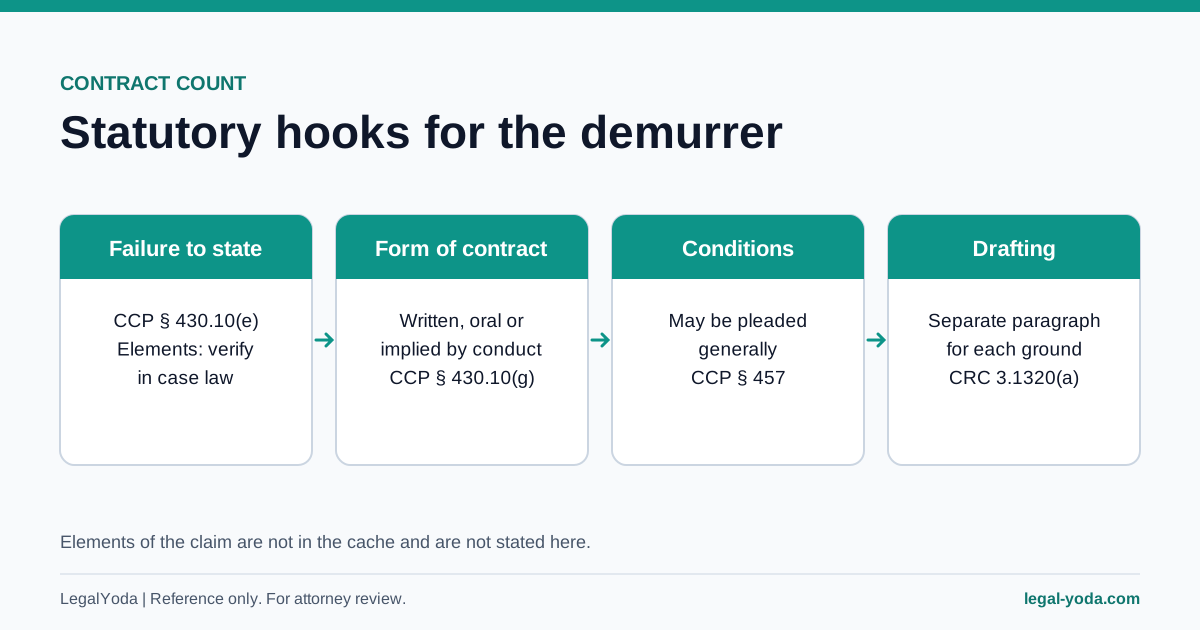
A breach of contract cause of action can be challenged by demurrer, and the Code of Civil Procedure has a few provisions written for contract pleadings. This article covers the procedural frame: which cached provisions apply, how a ground is drafted, and what the cache cannot supply. It does not state the elements of the claim or how courts apply them. Those come from case law, which the repo does not cache, and each has to be verified in a current source before it is cited.
Demurrer to a breach of contract claim in California: the statutory hooks
Two grounds in CCP § 430.10 are the ones in play. Subdivision (e) allows an objection that the pleading does not state facts sufficient to constitute a cause of action. Subdivision (g) is specific to contracts: in an action founded upon a contract, it cannot be ascertained from the pleading whether the contract is written, is oral, or is implied by conduct. Subdivision (f), uncertainty, can also apply to any pleading.
The pleading side is in CCP § 425.10(a)(1): a complaint contains a statement of the facts constituting the cause of action, in ordinary and concise language. A demurrer under subdivision (e) tests whether the facts stated meet the substantive requirements of the claim. The statute does not say what those requirements are for a contract claim, and this article does not either. Verify them in current case law.
The written, oral or implied ground
Subdivision (g) is narrower than it may sound. It is about whether the pleading says what kind of contract is sued on, not whether the contract was breached. It applies only in an action founded upon a contract, and it is a ground of its own that goes in its own paragraph under CRC 3.1320(a). The article on special demurrers lists it with the other grounds that go to form.
How courts apply the ground, including what in the complaint is enough to show the contract’s form, is a question for case law. Check it before relying on it.
Conditions precedent can be pleaded generally
CCP § 457 provides that in pleading the performance of conditions precedent in a contract, it is not necessary to state the facts showing performance. It may be stated generally that the party duly performed all the conditions on its part, and if the allegation is controverted, the party pleading must establish the facts at trial. The section is relevant to a demurrer that argues the complaint does not allege performance in enough detail. Whether a complaint’s allegations about its own performance meet the pleading rules is a matter for the section and for case law, not for assumption.
Where the contract text comes from: verify
CCP § 430.30(a) limits a demurrer to grounds appearing on the face of the pleading or from matter of which the court is required to or may take judicial notice. That raises the practical questions of whether the contract was attached to or quoted in the complaint, whether a court will read an attached document against the complaint’s allegations, and whether a contract not attached can be put before the court at all. None of those is answered by the cached text. Treat each as a case-law question to verify.
The same applies to a defense that depends on facts outside the pleading. Under § 430.30(b), when a ground does not appear on the face of a complaint, the objection may be taken by answer. A defense of that kind belongs in the answer, as CCP § 431.30(b)(2) describes, and a limitations defense also has its own pleading section, CCP § 458.
Drafting the demurrer
CRC 3.1320(a) requires each ground to be in a separate paragraph and to state whether it applies to the entire complaint or to specified causes of action. A complaint with a breach of contract count and other counts needs the contract grounds directed at that count by name. CCP § 430.50(a) allows the demurrer to go to the whole complaint or to any cause of action, and CRC 3.1320(b) allows a demurrer to one cause of action without answering the others.
The memorandum is limited to 15 pages under CRC 3.1113(d), with a table of contents and a table of authorities above 10 pages. A demurrer without a supporting memorandum risks a waiver of all grounds not supported, as CRC 3.1113(a) provides.
Meet and confer on a contract count
CCP § 430.41(a)(1) requires the demurring party to identify all of the specific causes of action it believes are subject to demurrer and to identify with legal support the basis of the deficiencies, and it requires the plaintiff to provide legal support that the pleading is sufficient or to explain how it could be amended. For a contract count, naming the missing facts or the unclear contract allegations in the conference letter is the way to satisfy the first part. The declaration under § 430.41(a)(3) is filed with the demurrer.
If the demurrer is sustained with leave to amend, the next steps follow CRC 3.1320(g) and (j) and the amendment limits in CCP § 430.41(e)(1). The article on leave to amend covers them.
Checklist
Items to confirm before a breach of contract demurrer is drafted:
- The elements of the claim and the cases applying them, taken from a verified current source (not stated here).
- Which ground applies to which count: CCP § 430.10(e), (f) or (g), each in its own paragraph.
- Whether the contract is attached or quoted, and what the court may consider (CCP § 430.30(a)).
- Whether conditions precedent are pleaded generally under CCP § 457.
- The meet and confer record and declaration (CCP § 430.41(a)).
Related articles
Reference only. Not legal advice. LegalYoda is a document preparation service, not a law firm.