The phrase special demurrer is common in practice, but the cached statutes do not define it. This article explains how the grounds in CCP § 430.10 are usually divided, which of them the cache supports, how to plead them under CRC 3.1320, and what the rule on memoranda says about grounds that are not argued. Where a point turns on case law, it is flagged for verification.
What special demurrer means
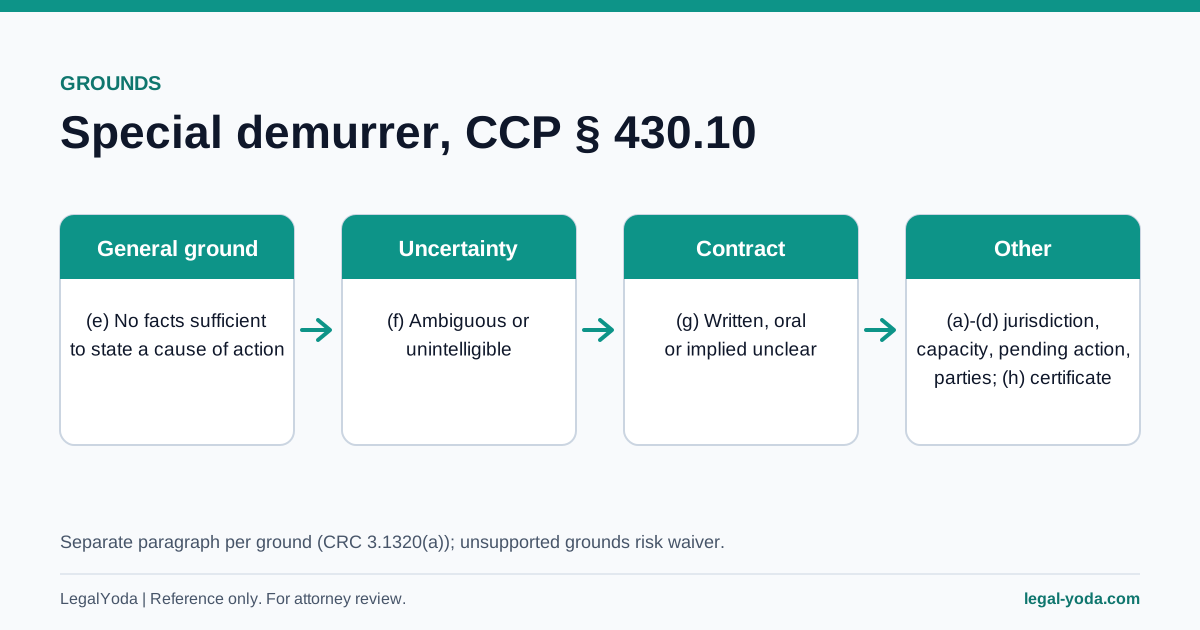
CCP § 430.10 lists eight grounds on which a party may object to a complaint or cross-complaint by demurrer. Subdivision (e) is the ground that the pleading does not state facts sufficient to constitute a cause of action. In practice that is the general demurrer, and the label special demurrer is applied to the objections other than subdivision (e). The cached statute does not use either label, so this division comes from practice, not from the text.
The only cached appearance of the phrase is in CRC 3.1113(a), where a court may construe the absence of a supporting memorandum as an admission that the motion or special demurrer is not meritorious. Read it with the full rule, since the cached excerpt is partial.
The grounds usually treated as special
The cached text of CCP § 430.10 lists these other grounds. Subdivision (a) is no jurisdiction of the subject of the cause of action. Subdivision (b) is that the person who filed the pleading lacks legal capacity to sue. Subdivision (c) is another action pending between the same parties on the same cause of action. Subdivision (d) is a defect or misjoinder of parties.
Subdivision (f) is that the pleading is uncertain, and the statute says uncertain includes ambiguous and unintelligible. Subdivision (g) applies in an action founded on a contract when it cannot be ascertained from the pleading whether the contract is written, oral, or implied by conduct. Subdivision (h) is that no certificate was filed as required by CCP § 411.35.
Uncertainty in practice
Uncertainty under subdivision (f) is the most common special ground. The statute defines the term only by the words ambiguous and unintelligible. How courts apply it, and how readily they sustain a demurrer on it, is a matter of case law that the cache does not hold. This article does not state a standard, and any case offered for one should be verified before it is cited.
Uncertainty is closely related to a motion to strike. CCP § 435 allows a motion to strike the whole or any part of a pleading, and CCP § 436 allows the court to strike irrelevant, false or improper matter. A pleading defect can sometimes be attacked either way, and the choice affects timing. CCP § 435(d) says a motion to strike does not extend the time to demur.
The face of the pleading and the answer alternative
CCP § 430.30(a) allows a demurrer when the ground appears on the face of the pleading, or from any matter of which the court is required to or may take judicial notice. Subdivision (b) provides that when a ground does not appear on the face of a complaint or cross-complaint, the objection may be taken by answer instead. A capacity or pending-action objection that depends on facts outside the complaint can therefore end up in the answer rather than a demurrer.
Subdivision (c) permits a party objecting to a complaint to demur and answer at the same time. A defendant with a ground that needs facts outside the pleading and another that does not can use both pleadings together. The demurrer then covers what the face of the complaint shows, and the answer covers the rest.
How to plead special grounds
CRC 3.1320(a) requires each ground of demurrer to be in a separate paragraph that states whether it applies to the entire pleading or to specified causes of action or defenses. For special grounds, that means a ground such as uncertainty should name the causes of action and, where the facts allow, identify the allegations that are unclear. CRC 3.1112(d)(4) separately requires a motion that challenges a pleading to state the specific portion challenged.
The same rules apply to every ground, general or special. CCP § 430.50 allows a demurrer to the whole complaint or to any of its causes of action, so special grounds can be directed at some causes of action and not others.
Waiver and the repeat-demurrer bar
CRC 3.1113(a) says that, for a demurrer, the absence of a supporting memorandum may be construed as a waiver of all grounds not supported. A special ground listed in the demurrer but not argued in the memorandum is exposed to the same reading, so each ground the demurrer asserts needs support.
CCP § 430.41(b) bars a party who demurs to an amended pleading, after a demurrer was sustained to an earlier version, from raising grounds that could have been raised against the earlier version. Special grounds left out of the first demurrer may be lost for the second, because the subdivision looks at what could have been raised, not at what was. The first demurrer should list every ground that is available.
Special grounds against an answer
CCP § 430.20 gives a party against whom an answer has been filed parallel objections: the answer does not state a defense, the answer is uncertain, or the answer pleads a contract and it cannot be ascertained whether it is written or oral. The same face-of-the-pleading rule in CCP § 430.30(a) applies.
Related articles
- General vs Special Demurrer in CaliforniaRead article
- Grounds for Demurrer in CaliforniaRead article
- Demurrer vs Motion to Strike in CaliforniaRead article
- Demurrer for Uncertainty: CCP § 430.10(f)Read article
- CCP 430.10(f): Uncertain Pleading DefinedRead article
- CCP 430.10(g): Written, Oral or ImpliedRead article
- CCP 430.10(b): Legal Capacity to SueRead article
- CCP 430.10(c): Another Action PendingRead article
- CCP 430.10(d): Defect or Misjoinder of PartiesRead article
Reference only. Not legal advice. LegalYoda is a document preparation service, not a law firm.