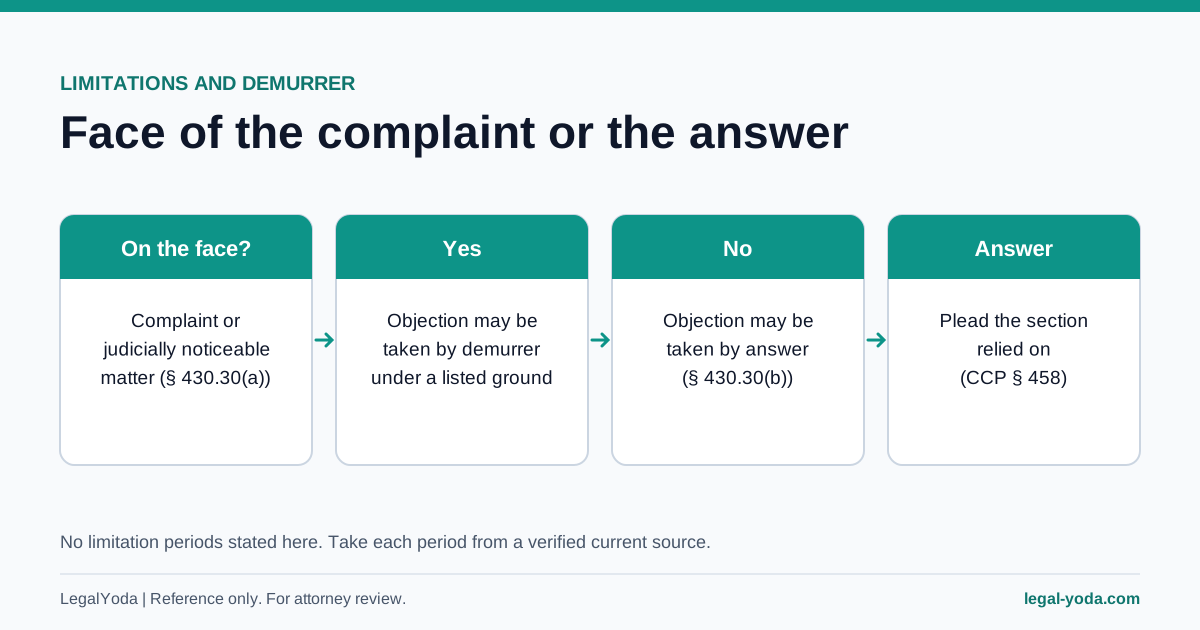
A limitations defense can be raised in more than one place in a California civil case. This article covers the procedural side only: when the cached statutes allow the point to be taken by demurrer, when they point to the answer, and what the meet and confer and the later-demurrer bar mean for how the point is raised. It does not state any limitation period. Periods depend on the cause of action and the current code, none of them is in the repo’s official-text cache, and each has to be taken from a verified source.
Demurrer and statute of limitations in California: the face of the complaint
CCP § 430.30(a) says that when any ground for objection to a complaint, cross-complaint or answer appears on the face of the pleading, or from any matter of which the court is required to or may take judicial notice, the objection on that ground may be taken by demurrer. Subdivision (b) says that when the ground does not appear on the face of a complaint or cross-complaint, the objection may be taken by answer.
That split drives the whole question. If the dates needed to show the claim is late are alleged in the complaint, or sit in a record the court may notice, the statute allows a demurrer. If they are not, the statute points to the answer. Which side of the line a given complaint falls on is a reading of that complaint, not a rule of law.
Which ground in CCP § 430.10 carries the point: verify
The cached text of CCP § 430.10 lists eight grounds, (a) through (h). None of them uses the word limitations. A demurrer must rest on one of those grounds, so the brief has to say which one it relies on. The grounds most often discussed in this setting are the failure-to-state ground in subdivision (e) and its relationship to the face of the pleading, but how courts connect a time bar to a listed ground is a matter of case law that the cache does not hold. Treat that connection as something to verify in a current, checked source before it goes into a notice of demurrer.
CRC 3.1320(a) adds a drafting rule: each ground of demurrer must be in a separate paragraph and must state whether it applies to the entire complaint or to specified causes of action. A limitations ground that applies to some causes of action and not others has to say so.
Pleading limitations in an answer
CCP § 458 addresses the answer. In pleading the statute of limitations it is not necessary to state the facts showing the defense; it may be stated generally that the cause of action is barred by the provisions of a named section of the Code of Civil Procedure, giving the section and subdivision relied upon. If that allegation is controverted, the party pleading it must establish at trial the facts showing the cause of action is barred.
CCP § 431.30(b)(2) separately provides that an answer to a complaint contains a statement of any new matter constituting a defense, and § 431.30(g) requires defenses to be separately stated and to refer to the causes of action they answer. Together these describe how the point is carried into the answer when it is not raised by demurrer, or when it is raised in both.
Demurring and answering together
CCP § 430.30(c) lets a party objecting to a complaint demur and answer at the same time. That leaves room to demur on the face of the pleading and plead limitations in the answer as well. Whether failing to raise a point by demurrer or answer has consequences is governed by CCP § 430.80, which is not in the cache. Read it in the current code before deciding what to leave out of either pleading.
Judicially noticeable dates
The statute allows a demurrer where the ground appears from a matter of which the court is required to or may take judicial notice. The rules on what the court may notice and how to ask are in the Evidence Code and the Rules of Court, which the cache does not hold for this purpose, so verify Evid. Code § 452 and the current rule on requests for judicial notice. Whether a court will treat a particular filing date or record as noticeable for this purpose is a question for case law.
Meet and confer, and the bar on a second demurrer
CCP § 430.41(a)(1) requires the demurring party to identify all of the specific causes of action it believes are subject to demurrer and to identify with legal support the basis of the deficiencies. A limitations ground needs the same treatment as any other: name the cause of action, name the dates and the authority.
Subdivision (b) matters for sequencing. A party demurring to a pleading that was amended after an earlier demurrer was sustained may not demur on grounds that could have been raised against the earlier version. A limitations point apparent from the first complaint is the kind of ground that statute is aimed at. How courts treat new allegations in an amended pleading is not in the cache; verify before relying on a later demurrer.
What the plaintiff can do in response
A plaintiff facing the point can oppose, seek leave to amend, or amend. CCP § 430.41(e)(1) limits amendments in response to a demurrer before the case is at issue to three, absent an offer of additional facts showing a reasonable possibility the defect can be cured. The standard a court applies to leave to amend, and what facts can cure a time bar, come from case law and are not stated here.
Checklist
Before a limitations point is placed in a demurrer, confirm each item against the file and the current code.
- The cause of action, the limitation section relied on, and the period, each taken from a verified current source.
- Where the dates appear: in the complaint, in a noticeable record, or nowhere on the face (CCP § 430.30).
- The listed ground in CCP § 430.10 that the demurrer relies on, stated in its own paragraph under CRC 3.1320(a).
- Whether to plead the defense in an answer as well, with the section named as CCP § 458 describes.
- Whether the point could have been raised earlier, given CCP § 430.41(b).
Related articles
Reference only. Not legal advice. LegalYoda is a document preparation service, not a law firm.