Uncertainty is one of the eight grounds in CCP § 430.10, and it is the one most closely tied to how a pleading is written rather than what it alleges. This article sets out the text of subdivision (f), how it connects to the drafting rules for a demurrer, and where the cached statutes stop and case law starts. It does not state how strictly courts apply the ground. That standard is not in the cache and has to be verified.
Demurrer for uncertainty in California: what § 430.10(f) says
CCP § 430.10 allows the party against whom a complaint or cross-complaint has been filed to object, by demurrer or answer as provided in CCP § 430.30, on any one or more of the listed grounds. Subdivision (f) reads: the pleading is uncertain. As used in this subdivision, “uncertain” includes ambiguous and unintelligible.
The same definition appears for an answer in CCP § 430.20(b), which lets a party against whom an answer has been filed demur on the ground that the answer is uncertain, again including ambiguous and unintelligible. The ground is therefore available against a complaint, a cross-complaint and an answer.
What the ground is aimed at
The text uses three words: uncertain, ambiguous and unintelligible. It does not say that a pleading is uncertain because it lacks detail a party could learn in discovery, and it does not say that it is not. How courts read the ground, including whether they treat it with disfavor, is case law. The cache holds none, so any characterization has to come from a verified current source.
The pleading standard in the cache is CCP § 425.10(a)(1): a complaint or cross-complaint contains a statement of the facts constituting the cause of action, in ordinary and concise language. An uncertainty argument is a claim that the pleading, read against that kind of requirement, cannot be understood. It is separate from the argument in subdivision (e) that the facts stated are not sufficient to constitute a cause of action.
Uncertainty and the special demurrer
California practice sorts demurrers into general and special. The cached rule CRC 3.1113(a) mentions a special demurrer by name, noting that a court may construe the absence of a supporting memorandum as an admission that the motion or special demurrer is not meritorious and, for a demurrer, as a waiver of all grounds not supported. The article on special demurrers treats subdivisions (f) and (g) of CCP § 430.10 as special demurrer grounds, and the article on general versus special demurrers covers that background.
One statutory limit is worth knowing. CCP § 92(c) states that special demurrers are not allowed. That section opens a set of rules about the pleadings allowed in certain cases, so which cases it governs has to be confirmed in the current code before it is applied to or against an uncertainty ground.
Drafting rules that apply to the notice and papers
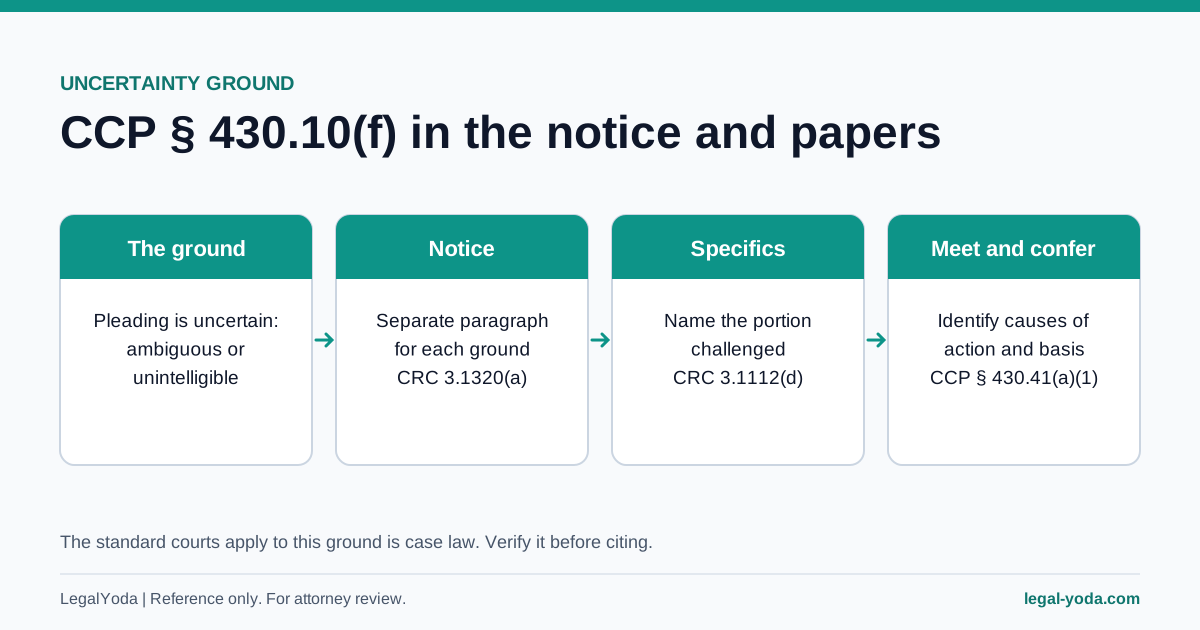
CRC 3.1320(a) requires each ground of demurrer to be in a separate paragraph and to state whether it applies to the entire complaint, cross-complaint or answer, or to specified causes of action or defenses. For an uncertainty ground, that means identifying the paragraphs or causes of action said to be unclear rather than saying the pleading as a whole is uncertain. CRC 3.1320(b) permits a demurrer to a cause of action without answering the other causes of action.
CRC 3.1112(d) requires a motion to state the specific portion of a pleading that is challenged. That fits an uncertainty ground naturally: the notice should say which allegations a reader cannot understand, and the memorandum should say why, with CRC 3.1113(a) requiring the memorandum itself.
Meet and confer on an uncertainty ground
CCP § 430.41(a)(1) requires the demurring party to identify all of the specific causes of action it believes are subject to demurrer and to identify with legal support the basis of the deficiencies. The other side must provide legal support that the pleading is sufficient, or explain how it could be amended to cure the problem. For uncertainty, the amendment answer is often the practical one: the conference is the point at which the plaintiff can say what the unclear paragraph was meant to allege.
If the conference produces an amended pleading, CCP § 430.41(a) requires the meet and confer again before a demurrer to the amended version, and § 430.41(b) bars a demurrer to the amended pleading on grounds that could have been raised against the earlier one. An uncertainty point not raised the first time may be foreclosed the second.
Checklist
Items to confirm before an uncertainty ground goes into a demurrer:
- Which paragraphs or causes of action are said to be ambiguous or unintelligible, listed specifically (CRC 3.1320(a), CRC 3.1112(d)).
- A verified statement of the standard courts apply to this ground, taken from current case law.
- Whether CCP § 92 applies to the case and, if so, what it allows (CCP § 92(c)).
- The meet and confer record on each specific allegation (CCP § 430.41(a)(1)).
- Whether the ground could have been raised against an earlier version of the pleading (CCP § 430.41(b)).
Related articles
Reference only. Not legal advice. LegalYoda is a document preparation service, not a law firm.