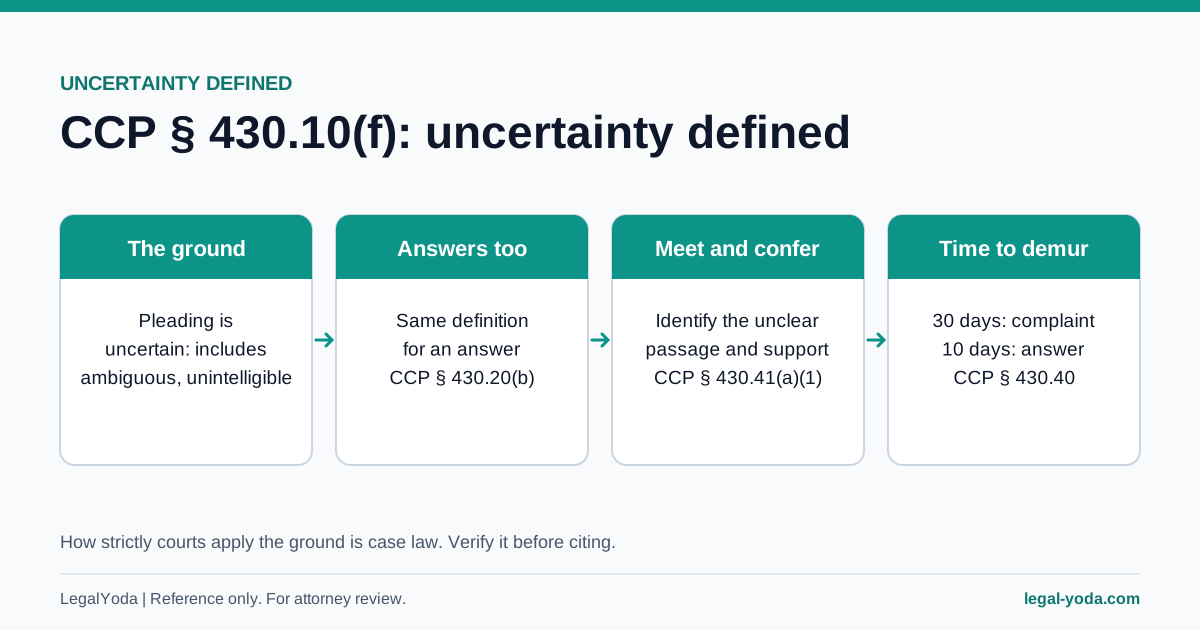
Subdivision (f) of CCP § 430.10 is the only ground in the section that carries its own definition: uncertain includes ambiguous and unintelligible. This article is the short reference on that subdivision. It covers the cached text, how CCP § 430.30, CCP § 430.41 and CCP § 430.40 apply, and what to confirm in the current code. The longer treatment of drafting rules and special demurrers is in the existing article on demurring for uncertainty, which this one links to rather than repeats.
CCP § 430.10(f): what the subdivision says
CCP § 430.10 allows the party against whom a complaint or cross-complaint has been filed to object, by demurrer or answer as provided in CCP § 430.30, to the pleading on any one or more of the listed grounds. Subdivision (f) reads: the pleading is uncertain. As used in this subdivision, “uncertain” includes ambiguous and unintelligible.
The second sentence is the only definition in the section. The word includes means the list is not stated to be closed, but the text names two members: ambiguous and unintelligible. Anything beyond those, and how much uncertainty is enough, is not in the statute.
The same definition for answers
CCP § 430.20(b) repeats the definition for demurrers to an answer: the answer is uncertain, and uncertain includes ambiguous and unintelligible. The ground is therefore available against a complaint, a cross-complaint and an answer. A paragraph written for any of the three should say which paragraph of the pleading is unclear and why.
How courts treat the ground: verify
The cache does not state how strictly courts apply the uncertainty ground. The existing LegalYoda demurrer guide cites Khoury v. Maly’s of California, Inc. (1993) 14 Cal.App.4th 612, 616, for the point that a demurrer for uncertainty is strictly construed. That should be read in the reporter and checked against later authority before the characterization is used, and the standard should be taken from current case law rather than from this summary.
CCP § 430.30 and the face of the complaint
Under CCP § 430.30(a), a ground that appears on the face of the pleading, or from a matter of which the court is required to or may take judicial notice, may be taken by demurrer. Under CCP § 430.30(b), a ground that does not appear on the face of a complaint or cross-complaint may be taken by answer. CCP § 430.30(c) allows both together.
Uncertainty is about the text of the pleading, so it is almost by definition on its face. The practical question is not which route is available but whether the unclear passage can be pointed to precisely. A reader of the notice should be able to find the paragraph in the complaint and see what is ambiguous or unintelligible about it.
General or special: a practice label to verify
Practitioners commonly call subdivision (f) a special demurrer ground. That comes from practice and case law, not from the cached text of CCP § 430.10, and should be verified. CRC 3.1113(a) is the cached rule that mentions a special demurrer, and it allows the court to construe a missing memorandum as an admission that the motion or special demurrer is not meritorious and, for a demurrer, as a waiver of all grounds not supported. CCP § 92(c) states that special demurrers are not allowed; confirm in the current code which cases it governs.
Meet and confer under CCP § 430.41
CCP § 430.41(a) requires a meet and confer in person, by telephone or by video conference before the demurrer is filed, and CCP § 430.41(a)(1) requires the demurring party to identify the specific causes of action subject to demurrer and the legal support for the deficiency. With an uncertainty ground the useful content of the letter is the passage that is unclear and what it could mean. The other side must provide legal support that the pleading is sufficient or explain how it could be amended to cure the problem, and for uncertainty an amended paragraph is the natural answer.
If an amended pleading is filed, CCP § 430.41(a) requires another meet and confer before a demurrer to it, and CCP § 430.41(b) bars a demurrer to a pleading amended after a demurrer was sustained on grounds that could have been raised against the earlier version. An uncertainty point not raised the first time may be foreclosed the second time. CCP § 430.41(d)(2) excludes unlawful detainer proceedings from the section.
Timing under CCP § 430.40
CCP § 430.40(a) allows a demurrer to a complaint or cross-complaint within 30 days after service, and CCP § 430.40(b) allows a party who filed a complaint or cross-complaint to demur to an answer within 10 days after service of the answer. CCP § 430.41(a)(2) requires the meet and confer at least 5 days before the responsive pleading is due and provides an automatic 30-day extension, by declaration, when the parties cannot meet in time.
CCP § 430.50 allows a demurrer to the whole pleading or to any cause of action, or, for an answer, to any of the defenses, and CRC 3.1320(a) requires each ground to be in a separate paragraph stating its target. CRC 3.1112(d) requires a challenged pleading’s specific portion to be stated.
Checklist
Items to confirm in the current code before a subdivision (f) paragraph is filed:
- The specific paragraphs said to be ambiguous or unintelligible (CRC 3.1320(a), CRC 3.1112(d)).
- The current standard courts apply to the ground, read in the reporter, including Khoury v. Maly’s of California, Inc.
- Whether CCP § 92 applies to the case (CCP § 92(c)).
- The meet and confer record on each passage (CCP § 430.41(a)(1), (a)(3)).
- Whether the point could have been raised against an earlier version (CCP § 430.41(b)).
Related articles
Reference only. Not legal advice. LegalYoda is a document preparation service, not a law firm.