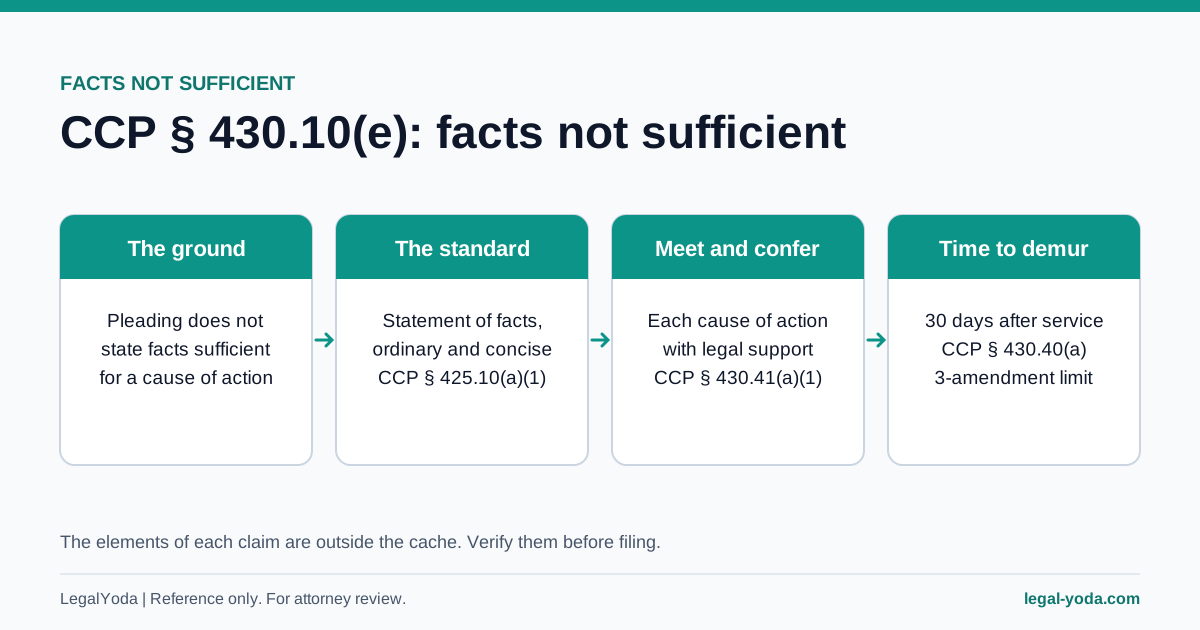
Subdivision (e) of CCP § 430.10 is the ground most demurrers are built on: the pleading does not state facts sufficient to constitute a cause of action. This article stays on that subdivision. It covers the cached text, the pleading standard it is measured against, the CCP § 430.30 face-of-the-pleading rule, the CCP § 430.41 steps and the CCP § 430.40 period. It does not set out the elements of any claim. Those come from the substantive law for the cause of action, which the cache does not hold.
CCP § 430.10(e): what the subdivision says
CCP § 430.10 allows the party against whom a complaint or cross-complaint has been filed to object, by demurrer or answer as provided in CCP § 430.30, to the pleading on any one or more of the listed grounds. Subdivision (e) reads: the pleading does not state facts sufficient to constitute a cause of action.
The ground is about facts and about a cause of action. It does not allege that the pleading is unclear, which is subdivision (f), or that a contract cannot be classified as written, oral or implied, which is subdivision (g). The same words appear for answers in CCP § 430.20(a), which allows a demurrer when the answer does not state facts sufficient to constitute a defense.
The standard the ground is measured against
The pleading rule in the cache is CCP § 425.10(a)(1): a complaint or cross-complaint contains a statement of the facts constituting the cause of action, in ordinary and concise language. Subdivision (e) tests whether the facts stated meet that description for the cause of action pleaded. The statute does not say what facts a particular claim requires, so the elements have to come from the substantive law for that claim.
The existing LegalYoda demurrer guide quotes Blank v. Kirwan (1985) 39 Cal.3d 311, 318, quoting Serrano v. Priest (1971) 5 Cal.3d 584, 591: “We treat the demurrer as admitting all material facts properly pleaded, but not contentions, deductions or conclusions of fact or law. [Citation.] We also consider matters which may be judicially noticed.” That quotation is reproduced from the guide and should be checked against the reporter before it is used in a filing (verify).
The same guide cites Aubry v. Tri-City Hospital Dist. (1992) 2 Cal.4th 962, 967, for the proposition that it is error to sustain a demurrer when the plaintiff has stated a cause of action under any possible legal theory (verify). For the demurring party, that points to addressing the theories the complaint reasonably suggests, not only the labels on each count.
CCP § 430.30 and the face of the complaint
CCP § 430.30(a) allows a demurrer when the ground appears on the face of the pleading or from any matter of which the court is required to or may take judicial notice. Under CCP § 430.30(b), a ground that does not appear on the face of a complaint or cross-complaint may be taken by answer, and CCP § 430.30(c) allows a demurrer and answer together.
For subdivision (e), the pleaded facts are the face of the complaint, so the ground is usually available by demurrer. A defense that depends on facts the complaint does not allege is not a sufficiency problem and has to be taken another way, such as by answer. Keeping those two apart in the notice avoids a paragraph that argues facts the complaint does not contain.
General or special: a practice label to verify
Practitioners commonly call subdivision (e), with subdivision (a), a general demurrer ground. That usage comes from practice and case law and not from the cached text of CCP § 430.10, and it should be verified before it is repeated. The cached rule that mentions a special demurrer, CRC 3.1113(a), also provides that a missing memorandum may be construed, for a demurrer, as a waiver of all grounds not supported. CCP § 92(c) states that special demurrers are not allowed; confirm in the current code which cases it governs.
Meet and confer under CCP § 430.41
This is the ground the meet and confer statute speaks to most directly. CCP § 430.41(a)(1) requires the demurring party to identify all of the specific causes of action it believes are subject to demurrer and to identify with legal support the basis of the deficiencies. For subdivision (e), that is the element or fact said to be missing, cause of action by cause of action, with authority. The other side must provide legal support that the pleading is sufficient or explain how it could be amended to cure any legal insufficiency.
CCP § 430.41(a)(3) requires a declaration with the demurrer about how the parties met and conferred. CCP § 430.41(a)(4) says that a determination that the process was insufficient is not grounds to overrule or sustain the demurrer.
Amendment limits that affect this ground
A plaintiff can often respond to a sufficiency ground by amending, and CCP § 430.41 has provisions on that. Subdivision (b) bars a demurrer to an amended pleading on grounds that could have been raised against the earlier version after a demurrer was sustained. Subdivision (c) lets the court order a conference after a demurrer is sustained with leave to amend. Subdivision (e)(1) limits amendments in response to a demurrer, before the case is at issue, to three, absent an offer to the court of additional facts showing a reasonable possibility the defect can be cured. The article on leave to amend covers how those fit together.
Under CCP § 430.41(g), if a demurrer is overruled as to a cause of action and that cause of action is not further amended, the demurring party preserves its right to appeal after final judgment without filing a further demurrer.
Timing under CCP § 430.40
CCP § 430.40(a) allows a demurrer within 30 days after service of the complaint or cross-complaint. CCP § 430.41(a)(2) requires the meet and confer at least 5 days before the responsive pleading is due and provides an automatic 30-day extension by declaration when the parties cannot meet in time. CCP § 430.50(a) allows a demurrer to the whole complaint or to any cause of action, and CRC 3.1320(a) requires the paragraph to say which, so a subdivision (e) paragraph is written cause of action by cause of action.
Checklist
Items to confirm in the current code before a subdivision (e) paragraph is filed:
- The elements of each challenged cause of action, taken from current substantive authority, and the pleaded fact said to be missing.
- That the argument stays on the face of the complaint and noticeable matter (CCP § 430.30(a)).
- The reporter text of any case quoted, including Blank v. Kirwan and Aubry v. Tri-City Hospital Dist.
- The meet and confer record for each cause of action (CCP § 430.41(a)(1), (a)(3)).
- The amendment history and the three-amendment limit (CCP § 430.41(b), (e)(1)).
- The separate paragraph and its target (CRC 3.1320(a)).
Related articles
- Demurrer for Failure to State a Cause of ActionRead article
- Grounds for Demurrer in CaliforniaRead article
- General vs Special Demurrer in CaliforniaRead article
- Demurrer Leave to Amend in CaliforniaRead article
- How to Write a Demurrer in CaliforniaRead article
- Demurrer to a Breach of Contract Claim in CARead article
- Demurrer to a Negligence Claim in CaliforniaRead article
Reference only. Not legal advice. LegalYoda is a document preparation service, not a law firm.