A demurrer is a written objection to a pleading. In California it tests whether the pleading is legally sufficient, without asking the court to decide who is telling the truth. This is the starting point for the other articles on this site, so it stays at the level of the statutes and rules in the repository’s cache and points to the longer articles for each step. It describes how the procedure is laid out; it does not tell anyone whether to demur.
What a demurrer is
CCP § 430.10 says the party against whom a complaint or cross-complaint has been filed may object to the pleading by demurrer or answer, as provided in CCP § 430.30, on any one or more of the listed grounds. A demurrer is one of the two vehicles for the objection. The other is an answer.
CCP § 430.30(a) ties the demurrer to the pleading itself: it is available when the ground appears on the face of the pleading, or from any matter of which the court is required to or may take judicial notice. When the ground does not appear on the face of a complaint or cross-complaint, subdivision (b) says the objection may be taken by answer, and subdivision (c) lets a party demur and answer at the same time. The article on requests for judicial notice covers the second source.
Where a demurrer fits in a case
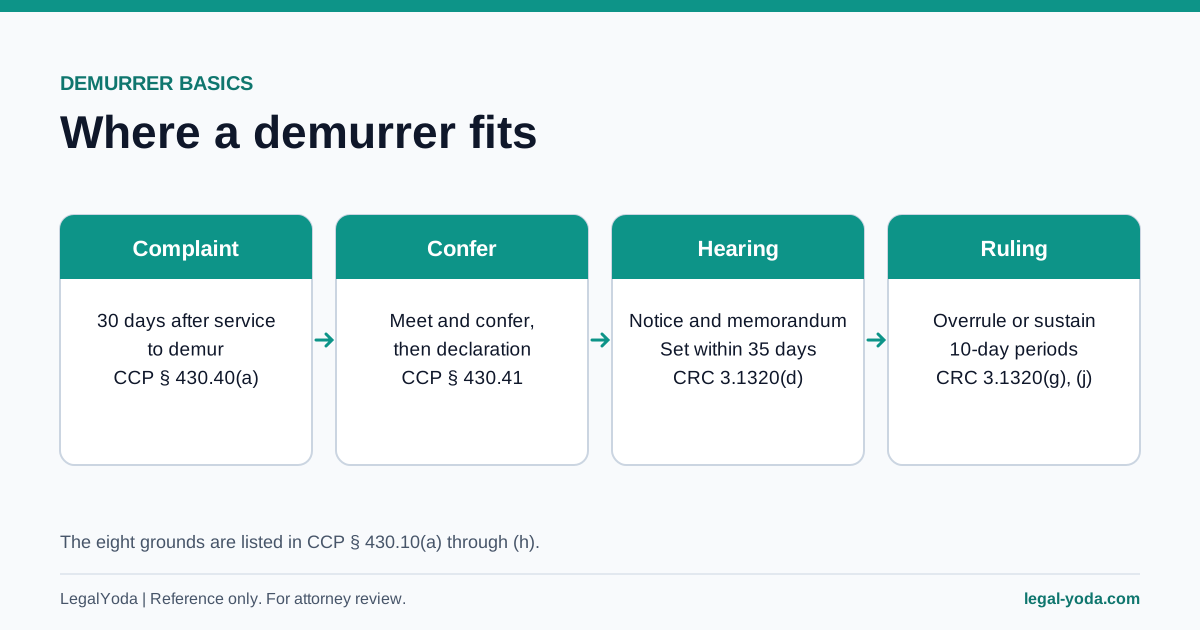
A civil case starts with a complaint. Under CCP § 425.10(a), a complaint contains a statement of the facts constituting the cause of action in ordinary and concise language, and a demand for judgment for the relief claimed. The summons directs the defendant to file a written response within 30 days after the summons is served (CCP § 412.20(a)(3)), and CCP § 430.40(a) allows a person against whom a complaint or cross-complaint has been filed to demur within 30 days after service.
Before the demurrer is filed, CCP § 430.41 requires the demurring party to meet and confer with the party who filed the pleading, with a declaration filed with the demurrer. The demurrer is filed with a notice of hearing (CRC 3.1320(c)), and the hearing is to be set not more than 35 days after filing or on the first date available to the court after that (CRC 3.1320(d)). The notice period for the motion comes from CCP § 1005(b).
After the ruling, the next step depends on the outcome. The next section lists the three outcomes and the articles that follow each one.
The grounds in CCP § 430.10
The cached text of CCP § 430.10 lists eight grounds. In the statute’s own order they are:
- (a) The court has no jurisdiction of the subject of the cause of action alleged in the pleading.
- (b) The person who filed the pleading does not have the legal capacity to sue.
- (c) There is another action pending between the same parties on the same cause of action.
- (d) There is a defect or misjoinder of parties.
- (e) The pleading does not state facts sufficient to constitute a cause of action.
- (f) The pleading is uncertain, which includes ambiguous and unintelligible.
- (g) In an action founded upon a contract, it cannot be ascertained from the pleading whether the contract is written, is oral, or is implied by conduct.
- (h) No certificate was filed as required by CCP § 411.35.
How the demurrer is built
Each ground of demurrer must be in a separate paragraph and must state whether it applies to the entire pleading or to specified causes of action or defenses (CRC 3.1320(a)). A demurrer to a cause of action may be filed without answering the other causes of action (CRC 3.1320(b)), and CCP § 430.50(a) allows a demurrer to the whole complaint or to any of the causes of action in it.
The demurrer needs a supporting memorandum. CRC 3.1113(a) allows the court to construe the absence of a memorandum as an admission that the motion or special demurrer is not meritorious and cause for its denial and, in the case of a demurrer, as a waiver of all grounds not supported. CRC 3.1113(d) caps an opening or responding memorandum at 15 pages and a reply at 10, with a list of exclusions.
The three outcomes and what follows
The court can overrule the demurrer, sustain it with leave to amend, or sustain it without leave to amend. Unless otherwise ordered, leave to answer or amend within 10 days is deemed granted after a ruling, and 5 calendar days in forcible entry, forcible detainer, or unlawful detainer actions (CRC 3.1320(g)). Unless otherwise ordered, the defendant has 10 days to answer or otherwise plead after an overruling, after the time to amend expires, or after a sustaining without leave to amend (CRC 3.1320(j)).
CCP § 430.41(e)(1) limits amendments in response to a demurrer before the case is at issue to three, absent an offer of additional facts showing a reasonable possibility of cure. Where a demurrer is overruled as to a cause of action that is not amended, subdivision (g) preserves the demurring party’s right to appeal after final judgment without filing another demurrer.
Demurring to an answer, and related motions
A demurrer is not limited to complaints. A party against whom an answer has been filed may demur to it on the grounds in CCP § 430.20, and a party who filed a complaint or cross-complaint has 10 days after service of the answer to do so (CCP § 430.40(b)). A demurrer to an answer may be taken to the whole answer or to individual defenses (CCP § 430.50(b)).
A motion to strike is a different tool. CCP §§ 435 and 436 deal with striking a pleading or part of one, and CRC 3.1322(b) requires a motion to strike to be noticed and heard at the same time as a demurrer when one is interposed. The article comparing a demurrer with a motion to strike lays out the differences.
Where to read next
The related articles below are grouped by step. For grounds, start with the grounds article and the general-versus-special comparison. For the preparatory steps, the meet and confer requirement and the letter and declaration article. For timing, the deadline, briefing-schedule and hearing-notice articles. For after the ruling, the hearing walk-through, the order, leave to amend and the time to answer.
The county demurrer pages linked in the sidebar collect stored local rules for each covered county, and the California deadline calculator and the motion types page are linked there as well. Statewide rules are only the starting point, because assigned departments often add their own procedures.
What this explainer does not cover
It does not state the elements of any cause of action, the standards courts apply to the grounds, or case law. The cache holds statutes and rules, not those standards. Where an article on this site relies on a case from the existing LegalYoda guide, it flags the case for verification. Nothing here replaces reading the current code and rules, and the choice whether to demur, answer or do both belongs to the attorney handling the case.
Related articles
- Grounds for Demurrer in CaliforniaRead article
- General vs Special Demurrer in CaliforniaRead article
- California Demurrer Meet and Confer RequirementRead article
- California Demurrer Deadline and ExtensionsRead article
- California Demurrer Hearing Notice RequirementsRead article
- How to Write a Demurrer in CaliforniaRead article
- How to Respond to a Demurrer in CaliforniaRead article
- Demurrer Leave to Amend in CaliforniaRead article
- What Happens at a Demurrer Hearing in CaliforniaRead article
- Demurrer vs Motion to Strike in CaliforniaRead article
Reference only. Not legal advice. LegalYoda is a document preparation service, not a law firm.